
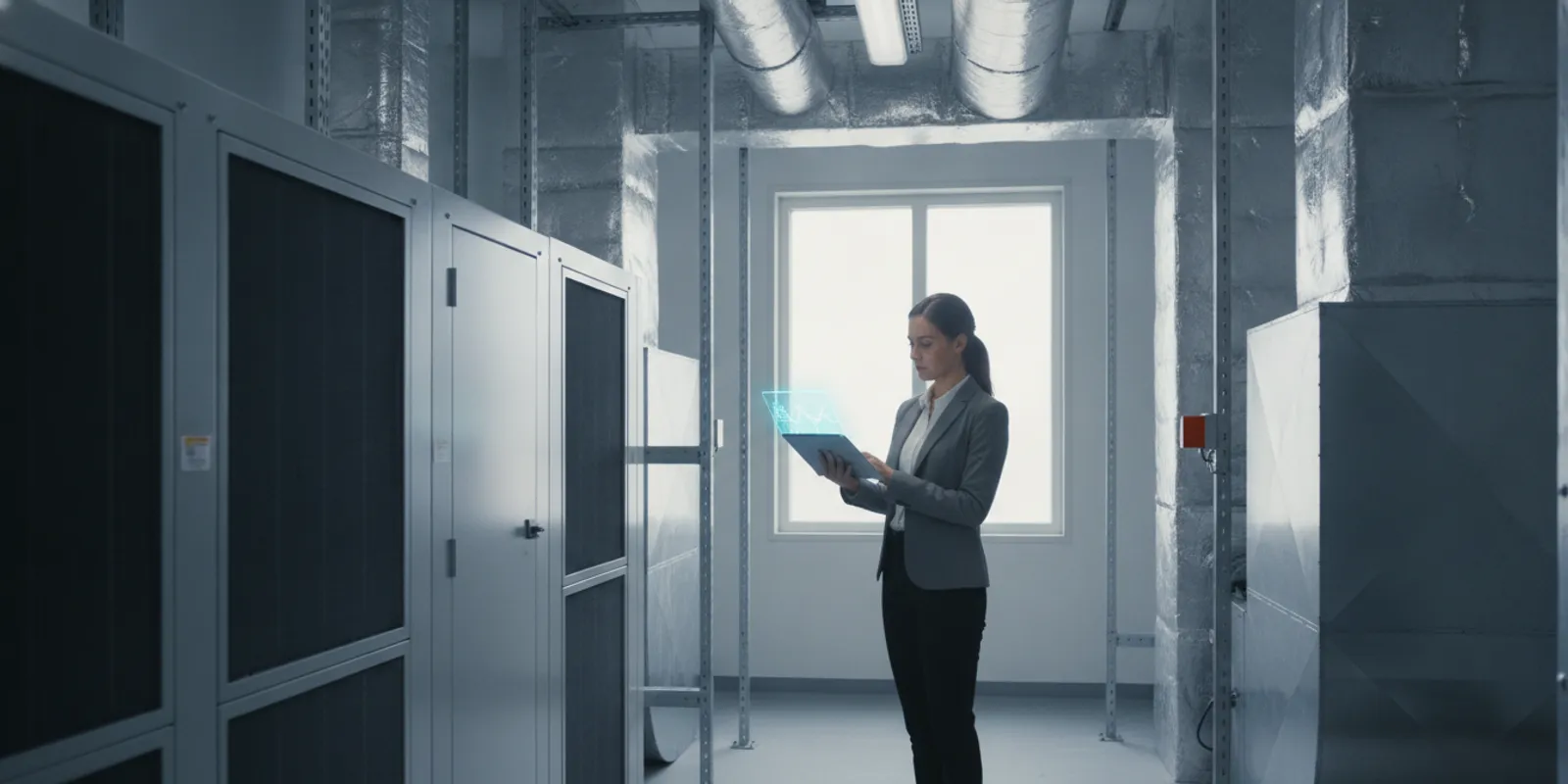
A commercial HVAC energy management system can help a facility team coordinate heating and cooling schedules, review available operating information, and plan follow-up. It is not a single guaranteed outcome or a substitute for sound equipment, maintenance, and informed decisions. The useful question is how controls and information can support the way your building is actually used. This guide explains what to assess, how to organize a review process, and what to ask before choosing an approach.
Call Airteks at (510) 719-0621 to discuss your commercial HVAC needs
What does a commercial HVAC energy management system do?
In everyday terms, a commercial HVAC energy management system brings together controls and operating information to help people manage heating and cooling. Depending on the building, equipment, and configuration, the arrangement may support schedules, temperature settings, equipment status, or alarms. Some facilities have basic controls at individual pieces of equipment. Others use connected controls or a building management platform for broader oversight.
The term describes a range of arrangements, not one fixed product or feature set. Before discussing a system, clarify what your team means by “management.” Is the main concern that schedules are hard to coordinate? Are operators looking for a common view of several systems? Does the building have recurring comfort reports that need better documentation? A clear problem statement makes it easier to compare appropriate options.
These tools can make information easier to review, but they do not automatically establish whether a building is comfortable, equipment is healthy, or settings are appropriate. Results depend on the system design, configuration, occupancy, maintenance, and follow-through by the people responsible for the building. The value is often better operational visibility and a more consistent way to decide what to investigate.
Which facility tasks can the system support?
Start by connecting a possible system to specific tasks. A facility team may want to coordinate opening and closing times, check whether equipment appears to be operating on schedule, or collect observations about a recurring issue. The controls and information are useful only when they fit a real process and someone is responsible for using them.
- Scheduling: Aligning HVAC operation with normal business hours, occupancy patterns, cleaning shifts, or known events.
- Setpoint coordination: Reviewing how temperature targets are established for different areas, within the needs of the building and its equipment.
- Operational review: Looking at available status information to identify questions for follow-up, rather than assuming a display alone diagnoses the cause.
- Alert response: Deciding who receives an alert, how it is assessed, and when a site check or qualified service is appropriate.
- Maintenance planning: Considering operating observations alongside inspection findings and service records.
- Portfolio coordination: Giving managers a repeatable way to compare schedules, open concerns, and responsibilities across locations without assuming every building operates identically.
For example, if a zone appears to run well outside its expected schedule, a manager can check for a one-time event, a schedule change, or an incorrect setting. If people report discomfort while the operating schedule appears normal, the team can record the time, location, and conditions and determine whether further investigation is needed. In either case, the system helps frame the question; it does not prove the underlying cause.
A useful workflow also specifies what not to do. Staff should know which people are authorized to change settings, how changes are recorded, and whom to contact when a change might affect other spaces or equipment. This helps prevent an informal adjustment from creating confusion for the next shift.
How do controls, monitoring, and maintenance work together?
Controls give equipment instructions, such as when to operate or what temperature to target. Monitoring makes selected operating information available for review. Maintenance involves attention to the physical condition of equipment and related components. These are connected parts of facility operations, but none replaces the others.
Consider a conference area that is too warm after a meeting. A schedule review might show that the system was set for ordinary occupancy, while the room was used by a larger group. That observation may prompt a review of schedules or operating needs. If the problem occurs repeatedly, the team may document the times and conditions and arrange a more detailed assessment. A control screen by itself cannot establish whether the cause is scheduling, equipment, the building, or another factor.
Or consider an alert that returns after it has been acknowledged. Repeated alerts deserve a consistent record: when they occurred, what was checked, whether staff observed a related comfort issue, and what next action was assigned. If information points to a mechanical concern, a qualified HVAC professional may need to inspect the equipment. Monitoring should help staff communicate the concern, not delay appropriate service.
Facility teams can connect the pieces by assigning three responsibilities: who reviews controls and schedules, who reviews alerts and observations, and who authorizes maintenance or service follow-up. Keep the notes in a shared location that staff can use. Airteks provides HVAC maintenance services and information about preventive HVAC maintenance; an appropriate service plan depends on the building, equipment, and operating requirements.
What should you assess before selecting an approach?
Begin with the facility’s work, not a list of technical features. A short baseline helps determine whether the current challenge is mainly about schedules, visibility, communication, or the physical condition of equipment. It also gives a professional a clearer starting point for discussing compatibility and scope.
- Record the building and equipment. List the kinds of HVAC equipment, the areas they serve, existing controls, and any known differences between zones. Note which systems are shared and which operate independently.
- Describe the operational problem. Use concrete examples: a schedule that changes seasonally, a room with recurring comfort reports, or staff who have difficulty seeing operating status across locations. Separate an observed symptom from an assumed cause.
- Map occupancy and exceptions. Identify ordinary hours, shifts, events, seasonal changes, and areas that are used on different schedules. Include who communicates changes when a space is occupied outside its usual hours.
- Identify users and decision rights. Name the roles that need to view information, adjust settings, receive alerts, and approve service. Decide how staff changes or absences will be covered.
- Ask about compatibility and connectivity. Find out what existing equipment can work with the proposed arrangement, what additions may be required, and whether site network or access policies affect the plan.
- Plan setup, training, and support. Clarify who will configure schedules, show staff how to use the system, address questions, and manage future changes.
- Set a review routine. Decide what information is worth checking, how often the team will review it, and how actions and results will be documented.
Use the same questions across a portfolio, but complete the assessment at each property. Two buildings with similar hours may have different equipment, zones, and occupant needs. A common reporting format can help managers compare open issues while leaving room for site-specific operating choices.
It can help to prepare a one-page baseline. Record the building’s normal operating hours, known schedule exceptions, the person responsible for updates, recurring comfort concerns, and current maintenance contacts. Add the date and source of each observation. That simple record distinguishes a continuing pattern from a one-off event and gives staff a practical reference during handoffs.
How do common approaches compare?
There is no single configuration that fits every commercial property. The table below is a planning aid, not a product recommendation. Actual capabilities depend on the equipment and the selected solution.
| Approach | What it may support | Useful when | Questions to resolve |
|---|---|---|---|
| Local controls or thermostats | Adjustment and schedules for individual areas or equipment | A small number of spaces have straightforward operating needs | Can staff manage devices consistently, and how are changes recorded? |
| Connected HVAC controls | Shared or remote access to compatible equipment and selected operating information | Operators need a broader view or coordination between users | Which equipment is compatible? What connectivity and access policies apply? |
| Building management platform | Central oversight of HVAC and potentially other building systems | The organization needs coordinated administration across systems or locations | What is included in scope, who administers it, and what training and support are needed? |
Compare the full operating arrangement, not just the interface. Ask what equipment is included, what is excluded, who performs setup, what information will actually be available, and who supports the team after configuration. A proposal should make assumptions visible, including any site work, staff time, network coordination, and continuing administration that may be needed.
Airteks describes its commercial HVAC services and commercial service areas. For a building that has a specific heating or cooling concern, reviewing the relevant commercial heating or commercial air conditioning service information can help frame the conversation.
How can teams plan schedules and review information?
A schedule should reflect how the building is used, including when people arrive, when spaces are occupied, and when staff need the system to prepare for use. Start with the ordinary weekly pattern. Then record exceptions such as holidays, special events, cleaning shifts, or seasonal operating changes. Avoid assuming that a single schedule suits every zone.
For each schedule, identify its owner and the method for requesting a change. A simple change record can include the affected area, requested dates and hours, person authorizing the change, person who updates the control, and a date to restore the usual schedule. That last step matters: temporary exceptions can become permanent by accident if no one owns the return to normal operation.
Review information with a defined purpose. A daily review might focus on current exceptions or alerts that need a decision; a less frequent review might look for recurring patterns and unresolved items. The interval should suit the building and staffing plan. Do not create a reporting routine that produces information no one has time to act on.
A useful issue record is concise. Include the date and time, location, what staff observed, the relevant schedule or status information if available, actions taken, and the person responsible for next steps. When the issue returns, the team can see what was previously tried and provide a clearer history to a technician. Protect access to building systems according to the organization’s own policies, and give permissions only to people who need them for their roles.
For multiple facilities, use a shared register with one line per site or open concern. Track the building contact, equipment notes, schedule owner, maintenance contact, and next review date. This gives managers a consistent view without requiring identical schedules or equipment at every property.
The U.S. Department of Energy’s HVAC Design and Implementation Guidance discusses planning an energy management program. The nonprofit American Council for an Energy-Efficient Economy also describes building energy management control systems for small and medium commercial buildings. These references can help facility teams place controls within a wider operating plan; the specific fit for a property still depends on its equipment and needs.
What does a practical review look like?
Imagine a property manager receives several reports that a shared area feels uncomfortable late in the day. The first useful step is not to assume that a particular control or component is at fault. Record the affected area, times, occupancy, and whether the reports coincide with a schedule or special event. Ask staff to note whether the condition is consistent or intermittent.
Next, compare those observations with the information the building’s controls make available. Confirm the schedule and any recent changes. Check whether the area has a different operating pattern from neighboring spaces. If a temporary adjustment is appropriate and authorized, document who made it and when it should be reviewed. Do not make broad changes that could affect other areas without understanding the system arrangement.
After a defined period, review whether the reports continued and whether the change addressed the concern. If the pattern persists, share the record with an HVAC professional and ask what further evaluation is appropriate. A concise, dated history can be more useful than a general statement that a room is “always too warm.” It also helps distinguish a scheduling question from an issue that may require inspection or service.
This process is useful even when the facility does not yet have a centralized management platform. The important elements are consistent observations, clear authority for changes, and follow-up. If a new system is considered later, the same records can help determine which information and workflows would genuinely be useful.
What should you ask an HVAC professional?
Before a discussion, gather the equipment and control details you have, current schedules, a description of recurring concerns, and any building access or network requirements that staff already know. It is fine if some details are missing; the purpose is to make the initial conversation specific.
- Which existing equipment and controls could work with the approach under consideration?
- What additional components, configuration, or site work might be needed?
- What information would facility staff be able to see, and what would remain outside the system?
- How will schedules be organized for different spaces and exceptions?
- Who should receive alerts, decide on follow-up, and authorize changes?
- What staff training and ongoing support should be planned?
- How should controls review be coordinated with equipment maintenance and service records?
- What should the team document before and after a change so it can evaluate whether the change helped?
Ask for explanations in terms of building tasks and responsibilities, not only technical features. For example, “How will the evening shift request a schedule change?” is more useful than a feature name without context. If several sites are involved, ask which parts of the approach can be standardized and which decisions should remain specific to each location.
Airteks serves commercial customers across Northern California, including the Bay Area, Central Valley, and Sacramento region. You can review the company’s commercial HVAC contractor guidance or learn about Airteks. Bring a clear description of the building and the operational issue so the discussion can focus on useful next steps.
Call Airteks at (510) 719-0621 to discuss your commercial HVAC needs
Frequently Asked Questions
Is a commercial HVAC energy management system the same as a thermostat?
No. A thermostat is one kind of control. An energy management arrangement may coordinate multiple controls or make selected operating information available for review, depending on the equipment and configuration.
Will a management system reduce energy use automatically?
No particular result is automatic. Schedules and settings need to suit the building, equipment must be appropriately maintained, and staff need to review relevant information and follow up. The outcome depends on the facility and how the system is used.
Can one system manage every building in a portfolio?
Some approaches can support broader oversight, but compatibility and operating needs vary by site. Review each building’s equipment, occupancy, connectivity requirements, and staffing before deciding whether a shared approach makes sense.
Does monitoring replace HVAC maintenance?
No. Monitoring can provide operating information, while maintenance involves attention to physical equipment. They can support one another, but a screen or alert does not replace appropriate inspection and service.
What information should we gather before discussing a system?
Start with equipment and control details, ordinary schedules, known exceptions, recurring concerns, user roles, and any connectivity requirements you know about. A few dated examples of an operational problem can help make the discussion more practical.
A useful commercial HVAC energy management system plan begins with clear facility needs, compatible equipment, and assigned responsibility for schedules and follow-up. Reviewing those basics with an HVAC professional can help your team identify a practical next step for the building.
Comments