
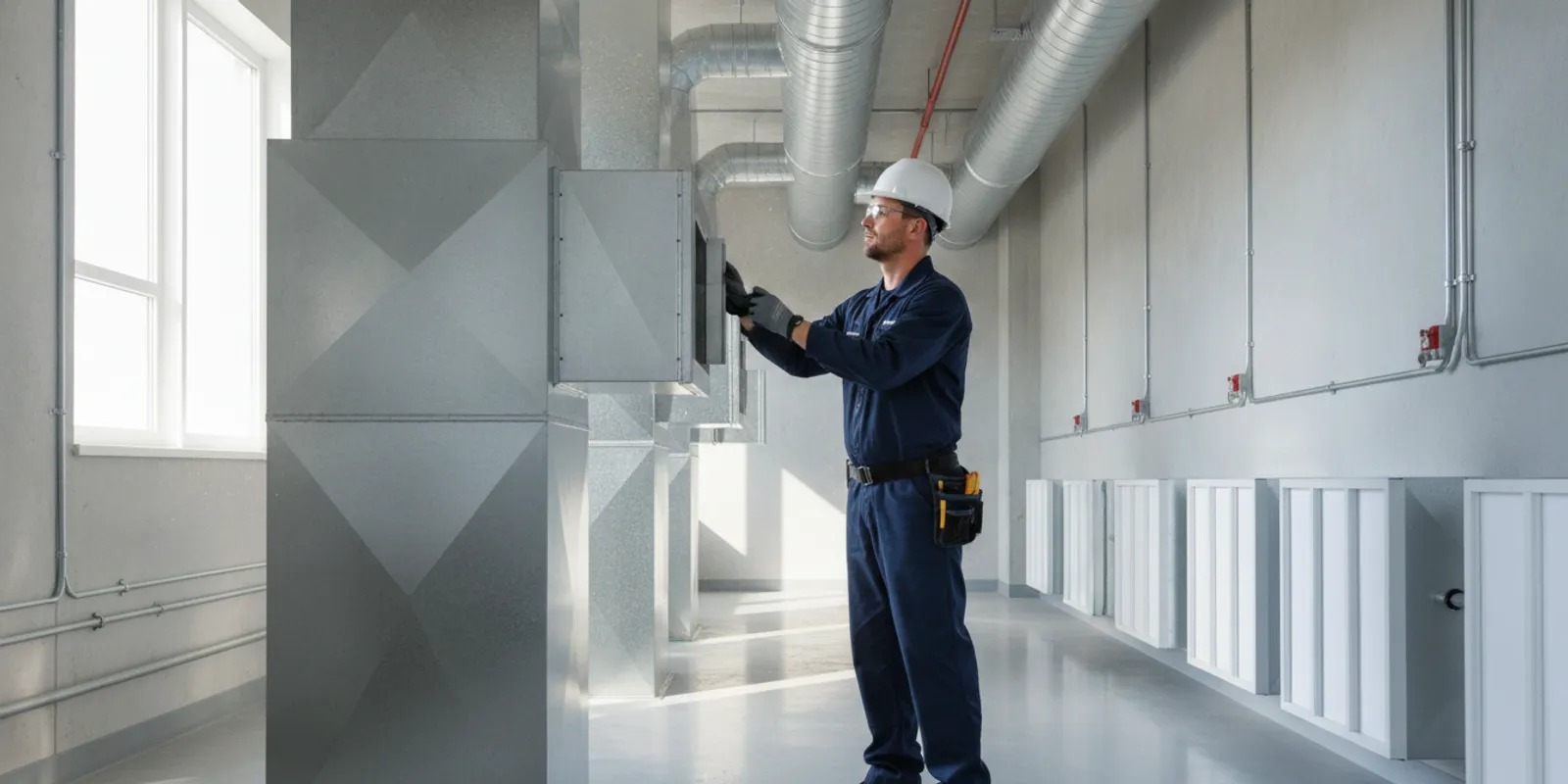
School indoor air quality HVAC planning is most useful when it connects the building’s ventilation, filtration, equipment operation, and maintenance routines instead of treating each as a separate project. Facility teams can start with observations, identify what the system can support, and prioritize practical steps that fit the building’s needs and operating schedule.
What should a school team include in an indoor air quality plan?
A useful plan begins with the actual building and the people responsible for operating it. A school may have classrooms, offices, gyms, libraries, kitchens, and other spaces with different occupancy patterns and ventilation needs. Before deciding that equipment needs replacement, document where concerns occur, when they occur, and what the HVAC system is doing at that time.
Give the review a clear scope. Identify the buildings and rooms involved, the person coordinating facilities, the maintenance staff who know the equipment, and the school contacts who can describe the issue. Note whether concerns are limited to one room, one system, a particular time of day, or a season. This information helps a facility team distinguish a localized operating problem from a wider building need.
- Describe the concern: Record the room, date, time, occupancy, weather conditions, and any recent changes to schedules or equipment.
- Check the operating context: Confirm whether the system was running, whether the room was in its normal use, and whether doors, windows, or schedules differed from usual.
- Review the system: Identify the equipment serving the area, its controls, filter type, and maintenance history.
- Assign follow-up: Name the person responsible for checking the issue again and keeping the record together.
Keep observations factual. A report of a stuffy room, an odor, or uneven temperatures can be useful, but it does not by itself identify the cause. HVAC operation is one part of an indoor environment that can also be affected by activities, building conditions, and sources unrelated to mechanical equipment. If a concern persists or involves health symptoms, use the school’s established facilities and health procedures rather than relying on an HVAC adjustment alone.
How can facility teams review ventilation and HVAC operation?
Start with the system’s intended schedule and compare it with the school’s real schedule. Check that occupied periods, after-school activities, and cleaning or event use are represented in the controls. Ask whether the system starts and stops as expected, whether a control has been changed, and whether a complaint follows a predictable pattern. A mismatch between actual use and programmed operation can be a practical issue to investigate.
Next, look for straightforward operating problems. A blocked outdoor-air intake, a closed or obstructed supply grille, an exhaust fan that is not operating, or a control setting that does not match the intended schedule may affect how a space is served. Staff can note visible conditions and report them; electrical, mechanical, or control work should be left to qualified personnel. Do not alter equipment beyond the staff member’s authorization or disable safety controls to try to improve air circulation.
Review maintenance records alongside these observations. Look for recurring service calls, filter changes, complaints that return after a repair, and systems that are difficult to access or operate. For a more complete understanding, a technician can inspect relevant equipment and discuss how the system serves the affected rooms. A commercial HVAC service review can help a school team frame questions about the building’s heating, cooling, and ventilation equipment without assuming the same solution fits every campus.
Do not treat a thermostat reading as a complete measure of indoor air quality. It describes one aspect of room conditions, not all ventilation or filtration performance. When the concern needs measurement or specialized assessment beyond routine HVAC service, coordinate with the appropriate school or building professionals and clarify who will interpret the results.
Which filtration questions should schools ask?
Before changing filters, identify what the equipment is designed to accept. The right filter choice depends on the system, the filter rack, airflow requirements, and the building’s goals. A filter that is not sized or installed correctly can leave gaps or interfere with the equipment’s intended operation. A more restrictive filter is not automatically an appropriate upgrade for every unit.
Ask maintenance staff or an HVAC professional to verify the filter dimensions and type specified for each system, confirm that the filter fits securely, and check the condition of the rack and access door. Make sure there is a clear process for recording replacement dates and noting unusual loading or damage. If one part of a building has a distinct system, do not assume the same filter specification applies everywhere.
When discussing a filtration change, have the contractor explain how the proposed option fits the existing equipment and what needs to be checked after installation. Consider whether staff can obtain and replace the filter reliably, whether access is safe, and how the maintenance schedule will be tracked. The goal is a suitable, properly maintained filter—not a specification selected without considering system capacity and operation.
Facility teams can use U.S. Environmental Protection Agency resources as a starting point for broader indoor-environment information, then confirm building-specific HVAC decisions with qualified professionals. General guidance does not replace a review of a particular school’s system, conditions, or applicable requirements.
How should schools compare practical HVAC actions?
Separate actions that staff can observe from decisions that require technical review. This makes the first response more orderly and helps the team avoid committing to equipment changes before understanding the problem. The table below is a planning aid, not a substitute for a site-specific inspection.
| Planning area | First step | What to document | When to involve HVAC support |
|---|---|---|---|
| Schedules and controls | Compare occupied hours with programmed operation. | Room use, schedule, control setting, and when the concern occurs. | When schedules appear correct but equipment does not respond as intended, or controls need adjustment. |
| Air pathways | Look for visible obstructions at grilles and intakes; report them. | Location, visible condition, and whether the issue recurs. | When access, repair, airflow evaluation, or mechanical work is needed. |
| Filters | Check records, fit, and replacement process. | Filter specification, change date, condition, and system served. | Before changing filter type or when fit, airflow, or equipment compatibility is uncertain. |
| Recurring room concerns | Log times, room use, and operating conditions. | Pattern across rooms, times, seasons, and recent changes. | When the issue persists or points to a system or building condition needing diagnosis. |
| Long-term maintenance | Review work history and recurring service needs. | Open issues, service dates, access constraints, and priorities. | When the school needs a preventive maintenance scope or a phased project plan. |
How can a school organize maintenance and follow-up?
A written maintenance routine makes it easier to see what has been checked and what remains open. Keep a simple record for each system or building area with the equipment served, last service date, filter information, reported concerns, work completed, and the next follow-up. Use the school’s existing work-order or facilities process when available, so staff do not have to maintain a disconnected set of notes.
When planning service, clarify access arrangements, school calendars, room priorities, and who can authorize work. For occupied campuses, coordination matters: the team should know which areas may be affected, when technicians can enter, and how changes will be communicated. If a repair or adjustment is recommended, ask what issue it addresses, what will be checked afterward, and whether any follow-up observation is useful.
Preventive maintenance should be based on the equipment, its use, its condition, and the manufacturer’s guidance. A consistent approach can include scheduled inspections, filter review, control checks, and attention to reported problems. Airteks provides HVAC maintenance services and preventive maintenance information for teams evaluating ongoing care. A service plan should be discussed in the context of the building’s systems and needs rather than assumed to be identical across campuses.
For districts with multiple sites, use a shared way to rank work while keeping building-level details visible. A short list can distinguish immediate operational checks, recurring maintenance needs, and larger planning items. Consider the effect on learning spaces, the condition and age of equipment as known to the district, access and scheduling limitations, and whether a temporary operating issue needs attention while a longer project is considered.
A practical review can follow a repeatable sequence: collect the report, check the schedule and service history, observe the relevant area, and identify whether an authorized operating check is appropriate. If the concern remains, arrange a technical review and record its findings. After any change, return to the original concern and check whether the pattern has changed under comparable conditions. This does not replace a formal assessment when one is needed, but it gives staff a consistent way to communicate and follow through.
For example, if staff report that one classroom feels uncomfortable during afternoon use, record the room’s schedule and occupancy, check whether the system serving it is scheduled to operate at that time, and review any recent work. If a routine check does not explain the pattern, share the notes with a technician and ask what additional inspection is appropriate. Avoid drawing a final conclusion from one observation or applying a setting change to other rooms without confirming how their systems operate.
How can teams distinguish ventilation needs from other concerns?
Ventilation, filtration, and temperature control are related, but they are not interchangeable. A room that feels warm may need a control or equipment check; a recurring odor may call for a broader look at activities, materials, exhaust, and building conditions. A filter change alone will not correct every issue, and increasing outdoor air without considering the system and its controls may not be the right first move. Record what is observed and ask for an assessment that addresses the specific concern.
For a classroom concern, compare it with nearby rooms served by the same equipment and with rooms on a different system, if that information is available. Note whether the concern occurs only during a particular class, after cleaning, during a schedule transition, or when the room is full. The comparison does not diagnose the cause, but it can help staff explain whether the pattern seems tied to a space, a schedule, or a wider area.
Also consider how the building is actually used. A room may have changed function, occupancy, or hours since the HVAC schedule was set. A gym or multipurpose space may host events outside normal school hours. The facilities team can check that these uses are known and determine whether the system’s programmed operation accounts for them. Share changes with the people responsible for controls and maintenance instead of relying on informal adjustments.
When the initial observations are inconsistent or do not explain a persistent concern, avoid repeatedly changing settings without keeping a record. Track the change, the date, and what happened afterward. This gives the next person a useful history and reduces the risk of making several changes at once, which can make it harder to understand what helped or what needs further review.
How should a district prioritize follow-up across several buildings?
When several schools report concerns at once, a shared intake process helps the district see patterns without losing the detail of each building. Use the same basic fields for every report: building and room, date and time, activity in progress, system or area involved if known, steps already taken, and the person assigned to follow up. Keep the original observations alongside any later interpretation so that the team can distinguish what staff noticed from what a technical review concluded.
Sort follow-up into manageable groups. Some items may be straightforward checks of schedules, access, or maintenance records. Others may need a technician to inspect a system or controls. Larger needs may call for planning, coordination with other building work, or a separate specialist assessment. A priority list should reflect the school’s operational needs and applicable district procedures; it should not imply that a brief HVAC visit can resolve a concern that needs a different kind of evaluation.
For each item, note the next action and the person responsible, then close the loop with the school contact who raised the concern. If the issue was addressed, record what changed and whether staff observed a difference. If it remains open, document the next review or the information still needed. This simple handoff prevents reports from disappearing between a school office, maintenance staff, and outside service providers.
At the district level, periodic review of these records can help identify repeated service needs, equipment that deserves closer evaluation, and maintenance tasks that need a more reliable schedule. The records also give decision-makers a clearer basis for deciding what to address first and what should be included in longer-term facilities planning.
When is an HVAC project or specialist assessment worth considering?
Routine service and a capital project solve different kinds of problems. A maintenance visit may address a filter issue, control setting, or identified equipment fault. A broader project may be appropriate when a system cannot reliably serve its intended areas, equipment needs are recurring, or the district is planning renovations or replacement. The decision should follow a review of the building and the school’s priorities.
Before scoping a project, gather available records: equipment schedules, service history, known comfort or ventilation concerns, room-use changes, and any previous assessments. Ask the project team to describe the observations supporting its recommendations and distinguish essential work from optional improvements. If multiple alternatives are proposed, compare what each is intended to address, required coordination, ongoing maintenance implications, and the information still needed to decide.
School facilities can involve specialized operating schedules and many different room uses. Airteks works with commercial and institutional properties, including school buildings, and can discuss how HVAC service or maintenance fits a facility’s needs. For district teams reviewing building-level needs, the commercial HVAC planning guide offers additional contractor-selection considerations, while the commercial heating service page explains one part of a broader building system.
Where indoor air quality concerns require testing, health evaluation, or building investigation beyond HVAC service, involve the appropriate qualified specialists and school authorities. Coordinate their findings with facilities staff so that any recommended HVAC work has a clear scope. The aim is to connect the evidence, the building’s operation, and the proposed action—not to assume every concern has a single mechanical cause.
What should facility teams ask an HVAC contractor?
Clear questions make a site discussion more useful. Share the location and timing of concerns, how the rooms are used, what has already been checked, and any relevant work history. Then ask the contractor to explain the system serving those areas in plain terms and identify which observations support the recommendation.
- Which equipment serves the rooms involved, and what operating condition did you observe?
- Is the recommendation a routine adjustment, repair, maintenance task, or larger project?
- How does the proposed filter or setting fit the equipment’s design and operating requirements?
- What should school staff monitor after the work, and when should they report back?
- Are there access, schedule, or room-use details the district should plan around?
- What is not included in the proposed scope, and what additional assessment might be needed?
Ask for the next step in writing when several people share responsibility for the building. A concise scope helps the facility team schedule work, communicate with school staff, and compare recommendations based on what they address. If a concern remains after service, share the follow-up observations so the next review starts with a clear record rather than an assumption.
Frequently Asked Questions
Does changing a school’s HVAC filter solve every indoor air quality concern?
No. A filter is one part of the HVAC system, and concerns can have different causes. Confirm that the filter is appropriate for the equipment, fits correctly, and is maintained, while also reviewing ventilation, operation, room use, and other relevant conditions.
Can school staff adjust HVAC equipment themselves?
Staff can record schedules, visible obstructions, and reported conditions, and follow authorized routine procedures. Mechanical or electrical work and changes requiring technical judgment should be handled by qualified personnel. Follow district safety and facilities policies.
What information should a school collect before requesting service?
Record the affected rooms, dates and times, occupancy or activities, whether the issue repeats, recent schedule or building changes, and any relevant maintenance history. These details help a technician focus the review.
Should every classroom have the same HVAC settings?
Not necessarily. Systems, room uses, schedules, and equipment may differ. A facility team should review the building’s design and operating needs rather than applying one setting or filter choice everywhere without checking compatibility.
What is the next step for your school building?
Start with a clear record of what people are experiencing, what the HVAC system is doing, and what has already been checked; then use that information to plan the right follow-up for the building.
Comments