
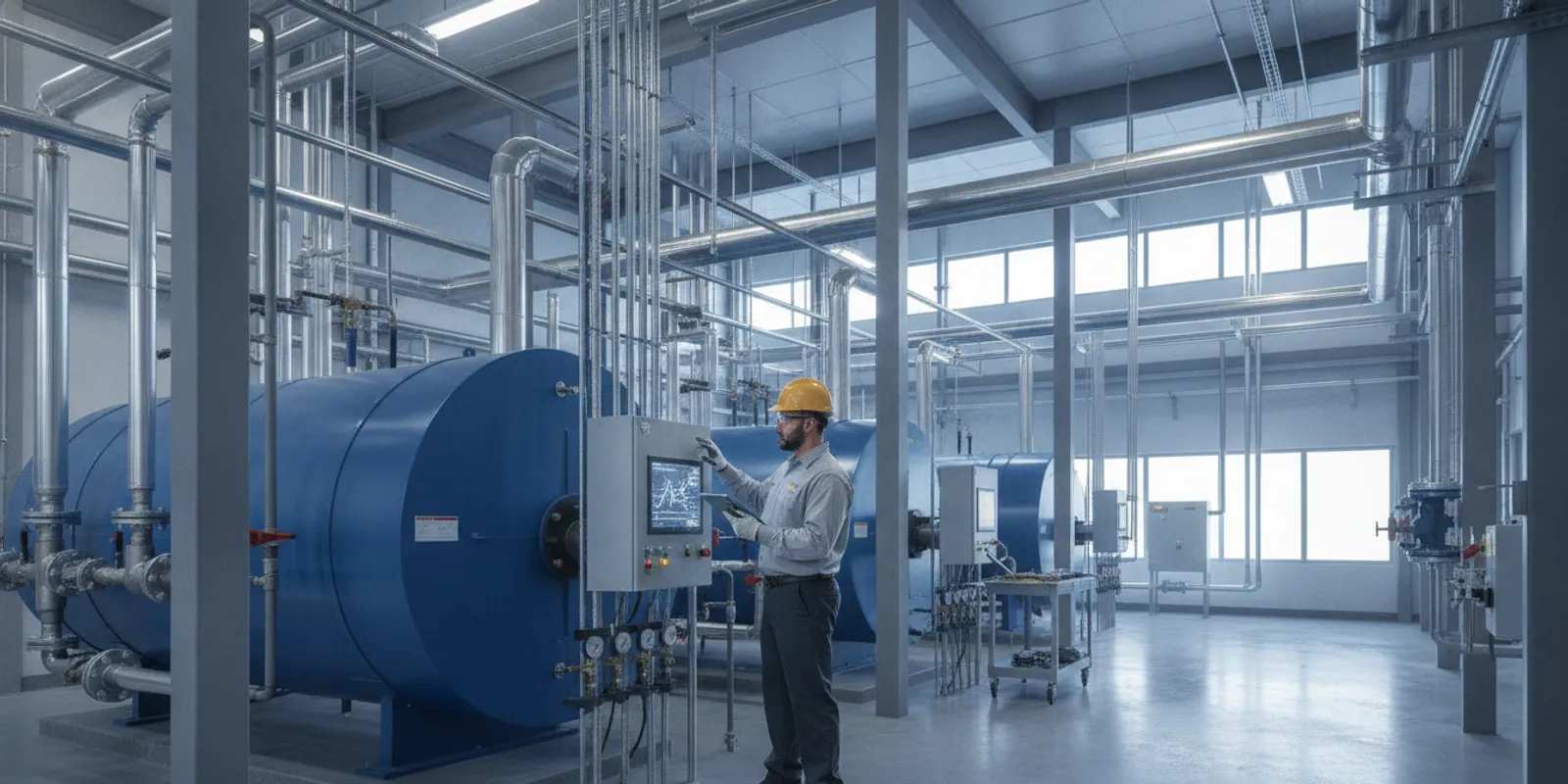
Commercial boiler efficiency upgrades Northern California facilities can consider range from control adjustments to equipment changes. The right choice depends on how the boiler plant operates, how heat is distributed, and what the building needs—not on a single product or efficiency label. A structured assessment helps facilities teams find practical improvements and avoid paying for work that does not address the actual operating issue.
Talk with Airteks about a commercial boiler evaluation
What should an efficiency upgrade accomplish?
An efficiency project should improve how effectively the heating plant delivers useful heat while meeting the building's operating needs. That means looking beyond the boiler nameplate. A boiler can be correctly sized and maintained yet still waste energy if it runs when there is little demand, cycles too often, sends hotter water than needed, or loses heat through poorly insulated distribution piping.
Start by identifying a measurable objective. Examples include reducing unnecessary run time, improving temperature control in occupied areas, reducing short cycling, or correcting a recurring imbalance between the plant and the building. An objective makes it easier to compare proposals and later verify whether the work had the intended effect.
Keep comfort, reliability, and safe operation in view alongside energy use. A change that lowers boiler runtime but leaves occupied spaces cold is not a successful upgrade. Nor should an efficiency project bypass manufacturer instructions, required inspections, or qualified service. Facilities managers can describe symptoms and operating schedules; diagnosis and adjustments to combustion or safety controls belong with qualified HVAC professionals.
How do you identify the best opportunities?
Build a simple picture of the system before choosing a measure. Collect recent fuel use if available, outdoor conditions or heating-degree information used by your organization, occupied schedules, control setpoints, maintenance records, and notes about comfort complaints. Compare periods with similar building use where possible. A bill total alone cannot show whether changes came from weather, occupancy, operating hours, or equipment performance.
Walk through the plant and the served areas with the people who operate the building. Ask when the boiler starts, whether it runs overnight or during unoccupied periods, which zones are slow to warm, whether the system frequently starts and stops, and what happens during mild weather. Confirm what equipment each boiler serves and whether boilers operate together or in rotation.
- Check operating schedules. Compare the programmed schedule with actual occupancy, warm-up needs, and after-hours use.
- Review control behavior. Note setpoints, outdoor reset settings if present, staging sequence, and any overrides that have become permanent.
- Inspect the distribution side. Look for damaged or missing pipe insulation, unusual temperature differences, and recurring balancing concerns.
- Review trend or service data. If available, use boiler starts, run hours, supply and return temperatures, and alarm history to find patterns.
- Document constraints. Note access limits, seasonal deadlines, tenant or school calendars, and whether heating can be interrupted.
These observations do not replace a technical assessment. They help a contractor investigate the relevant parts of the plant instead of treating every boiler room as though it has the same problem. Airteks provides commercial heating services and commercial HVAC services for facilities planning heating work.
Which upgrade types should you compare?
Efficiency work may involve controls, boiler operation, distribution, or equipment. Some measures are modest and targeted; others require design, coordination, and a larger project scope. The table below is a planning aid, not a substitute for a site-specific recommendation. Costs are intentionally described by relative scope because actual pricing depends on the equipment, building, access, and work required.
| Upgrade area | What it addresses | Typical project scope | What to verify |
|---|---|---|---|
| Scheduling and control settings | Unneeded run time, poor staging, or controls that do not match occupancy | Review, configuration, and functional testing; may be limited if controls are in good condition | Heating schedules, setpoints, boiler sequence, and operation during occupied and unoccupied periods |
| Outdoor reset or water-temperature control | Supply water that may be hotter than the building needs during milder conditions | Control review, sensor checks, setup, and testing across operating conditions | Comfort, stable operation, return-water conditions, and the boiler maker's operating limits |
| Boiler sequencing and staging | Multiple boilers operating inefficiently or cycling rather than matching load | Sequence review and controls work; complexity increases with plant design and control integration | Lead-lag logic, minimum run behavior, changeover, and response to changing demand |
| Distribution improvements | Heat loss from piping or uneven delivery to served areas | Insulation repair, valve or balancing assessment, and related piping work | Pipe condition, access, temperature differences, and whether complaints are resolved |
| Combustion or burner controls | Burner operation that needs qualified testing, adjustment, or control improvements | Professional inspection and testing; scope depends on burner and boiler configuration | Combustion readings, safe operation, manufacturer requirements, and documented results |
| Condensing boiler operation or equipment | Opportunity to operate condensing equipment under conditions that support condensation, or replace unsuitable equipment | May require return-water assessment, controls or system changes, or a larger equipment project | Return-water temperatures, load profile, design compatibility, condensate provisions, and full installed scope |
Why do return-water temperatures matter?
For a condensing boiler, return-water temperature is an important design and operating consideration. The equipment can recover additional heat from its exhaust when operating conditions allow condensation. But installing a condensing boiler does not by itself ensure that the system will operate in a way that takes advantage of that capability. The heating distribution system, water temperatures, load, controls, and boiler setup all affect the result.
The U.S. Environmental Protection Agency's ENERGY STAR commercial boiler guidance discusses efficient design, installation, and operation of packaged boiler systems, with emphasis on condensing operation and low return-water temperatures. Read the ENERGY STAR commercial boilers guidance as background when evaluating this type of opportunity.
Ask the contractor how return-water conditions were measured or estimated, what the building's heat emitters require on colder days, and whether any control changes could support lower water temperatures during milder weather. The answer should account for the whole system. Lowering a setpoint without checking comfort, equipment limits, and distribution behavior can create a new problem rather than an improvement.
When should controls be part of the project?
Controls determine when equipment runs and how it responds as demand changes. In a multi-boiler plant, sequencing can influence whether the lead boiler carries an appropriate share of the load and when additional boilers come on. Scheduling can prevent unnecessary operation outside occupied hours, while temperature reset strategies can vary water temperature as conditions change. Each strategy must be configured around the actual plant and building.
Ask for a description of the current sequence and the proposed sequence in plain language. The proposal should explain what signals trigger a boiler to start or stop, how boilers rotate, what happens during a control fault, and how the new setup will be tested. Include any existing building automation or wireless control systems in the discussion; do not assume a new control layer will automatically communicate with existing equipment.
California Energy Commission docket material includes workpaper reporting on burner-control measures in PG&E's Boiler Efficiency Program. It is useful context for why control measures may be evaluated, but program workpaper results should not be treated as a guarantee for a particular building. See the California Energy Commission docket document and ask for a site-specific explanation of the expected operating change.
Airteks offers building control systems and is a Pelican Wireless Systems dealer, according to its company information. For a facilities team considering building-level control coordination, review the available Pelican Wireless system information and ask how the proposed scope fits the boiler plant and existing controls.
How can distribution improvements support boiler performance?
A boiler plant can operate as intended while the building still experiences uneven heating. Insulation gaps on accessible hot-water pipes can contribute to heat loss before water reaches the served space. Air or balancing problems, control valve issues, and changes to a building can also affect how heat is delivered. These symptoms do not prove that the boiler itself needs replacement.
Ask for a system-level review when occupants report that one area overheats while another remains cold, or when the boiler seems to run for long periods without resolving a comfort problem. The contractor should clarify whether the likely issue is at the boiler, in the distribution system, or in zone controls. Document which areas are affected and when; that detail is more useful than a general note that the building is uncomfortable.
For project planning, distinguish between work that improves delivery and work that changes heat production. Pipe insulation, valve repairs, control adjustments, and balancing are not interchangeable measures, and not every building needs all of them. A clear scope should connect each proposed task to an observed condition.
How should you decide between tuning, upgrades, and replacement?
Start with a condition and operating assessment. If the equipment is serviceable and the problem is a schedule, sensor, sequencing, or distribution issue, a focused adjustment or repair may be the logical first step. If the boiler is near the end of its useful life, has persistent operating problems, or cannot meet the facility's requirements, compare upgrade work with a planned replacement project. Avoid assuming replacement is necessary based only on age, and avoid assuming a small controls change will solve a physical capacity or condition problem.
For each option, request the same basic information: the observed issue, proposed work, assumptions, expected operational change, exclusions, access needs, shutdown requirements, and how completion will be tested. Ask whether the contractor expects additional work after opening or inspecting equipment and how that would be approved. A proposal that separates necessary work from optional items is easier to evaluate than a single bundled recommendation.
There is no single payback calculation that fits every commercial site. If a proposal includes projected savings, request the baseline, operating assumptions, utility rates used, and whether the estimate accounts for weather, occupancy, or schedule changes. Treat projections as estimates, not guaranteed outcomes. Consider non-energy factors too, such as comfort, operating consistency, equipment condition, and the cost of coordinating work during a limited shutdown window.
If work may expand into broader heating-system changes, compare the scope with the facility's long-term plans. Airteks has a guide to choosing a commercial HVAC contractor that can help facilities teams think through contractor fit and project communication. For a service or project discussion, the company's commercial service areas page lists its service coverage.
What should you include in a project request?
A concise request for evaluation helps contractors prepare and gives your team a basis for comparing responses. Include the following where available:
- Facility type, location, served areas, and usual occupied hours.
- Boiler make, model, fuel, age if known, and the number of boilers in the plant.
- Heating complaints or operating concerns, with dates, locations, and conditions.
- Recent operating, maintenance, and repair records, plus available trend data.
- Existing controls, schedules, setpoints, and any known overrides or alarm history.
- Access instructions, safety or site requirements, blackout dates, and shutdown limits.
- The outcome you want to assess, such as fewer unoccupied run hours, better staging, or more consistent heat.
Ask the contractor to explain what diagnostic steps are included and what information will be documented. If data is not available, ask whether it should be collected before deciding on equipment or controls. Your team can also use Airteks' HVAC maintenance information to consider how ongoing service planning relates to the proposed work; maintenance and efficiency upgrades are related but are not the same project.
How can you verify the result?
Agree on a practical verification plan before work starts. Define what will be checked, who will check it, and under what operating conditions. Depending on the project, verification may include confirming schedules and setpoints, observing boiler staging, reviewing supply and return temperatures, checking alarms, or documenting combustion test results from qualified service personnel. Match the verification method to the measure rather than asking for a vague promise of improved efficiency.
Keep a record of the final settings, sequence description, test results, and any remaining recommendations. Compare operation over a suitable period, taking weather, occupancy, and schedule changes into account. If the intended change does not appear, revisit the original diagnosis and operating data before adding more measures. A documented baseline and closeout make future decisions easier.
Plan to communicate operating changes to building staff. A control schedule can be overridden, a sensor can be moved, or a later change in occupancy can make an old schedule unsuitable. Assign someone to report unexpected comfort changes and note who is authorized to change settings. This simple handoff helps protect the intended setup after the project team leaves.
Request a conversation about your boiler upgrade priorities
Frequently Asked Questions
Do all commercial boiler efficiency upgrades require new equipment?
No. Some opportunities involve schedules, staging, sensors, controls, or heat distribution. An assessment should determine whether the boiler, controls, piping, or building operation is the source of the concern before equipment replacement is considered.
Can a condensing boiler save energy in any existing building?
Not automatically. Condensing performance depends on operating conditions, including return-water temperature, as well as system design and controls. Have the contractor evaluate the full heating system and explain how the proposed design will operate in the building.
How do we know whether control settings are contributing to waste?
Review schedules, boiler starts and run hours, setpoints, staging, and any permanent overrides. Trends or service records can help show when equipment operates. A qualified contractor can check how the controls respond under actual building conditions.
What should we ask before approving an efficiency project?
Ask what condition the work addresses, what is included and excluded, how it will affect operation, what assumptions support any savings estimate, how completion will be tested, and what documentation your team will receive.
What is the next step for a facility team?
Begin with operating information, comfort observations, and a clear project objective. Compare targeted control or distribution work with larger equipment options only after the system's condition and behavior are understood. A site-specific review can help your team set priorities, coordinate the work around facility needs, and define how to confirm the result.
Comments