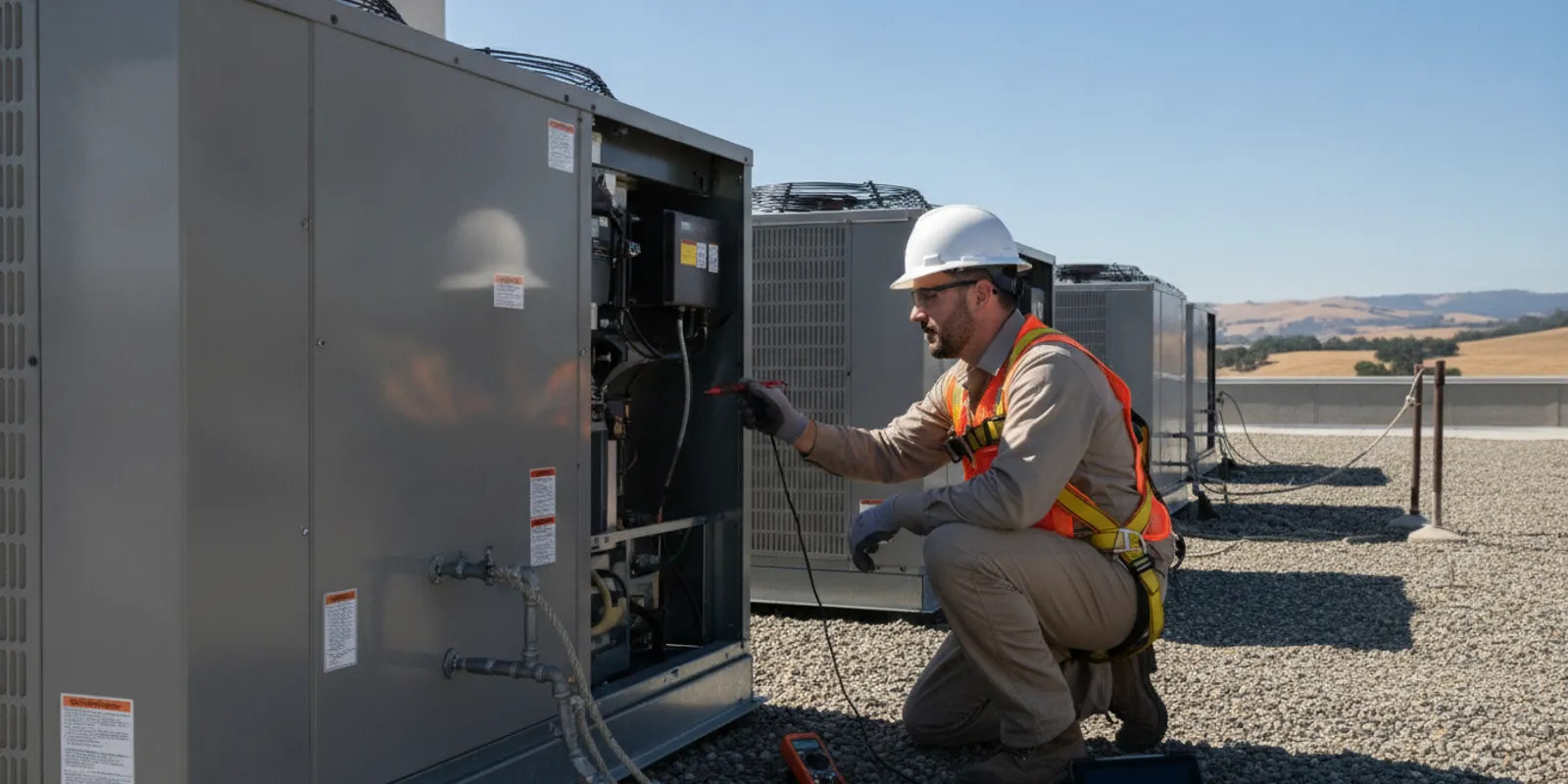
When a commercial rooftop unit starts struggling, the immediate question is whether a repair can restore dependable operation or whether it is time to plan a replacement. These commercial rooftop unit replacement signs Northern California facility teams should watch for include repeated breakdowns, uneven comfort, persistent performance changes, and repair needs that keep returning. No single symptom proves that a unit must be replaced. The useful decision comes from looking at the equipment’s condition, operating history, and the needs of the building together.
Request a commercial HVAC assessment
Which rooftop unit problems may point toward replacement?
A rooftop unit, or RTU, packages heating and cooling components in one piece of equipment, commonly installed on a building roof. It serves the areas connected to its ductwork and controls. Because the equipment is exposed to weather and handles daily heating or cooling demand, a change in its performance deserves attention. Still, symptoms can come from more than one source. A control setting, airflow restriction, electrical issue, thermostat problem, or duct condition may produce complaints that resemble a failing unit.
Look for patterns rather than relying on one bad day. A single service call may address an isolated fault. Repeated calls for the same system, or several related problems appearing over time, provide a stronger reason to assess whether continued repair remains practical. Ask the service provider to explain what was found, what was corrected, and what should be monitored next.
- Recurring failures: The same unit returns to service with a similar fault, or new issues appear soon after a repair.
- Inconsistent comfort: Occupants regularly report hot or cold areas, weak air delivery, or difficulty maintaining the expected temperature.
- Long or disruptive outages: Heating or cooling interruptions interfere with business operations, tenant comfort, or facility schedules.
- Declining performance: The system seems to run for longer periods or struggles to meet demand, after basic operating conditions have been checked.
- Visible deterioration: A qualified technician observes corrosion, damaged cabinet areas, or other physical wear that affects the condition of the equipment.
- Changing building needs: A renovation, a change in occupancy, or new operating hours may mean the current system no longer matches how the space is used.
These are prompts for investigation, not automatic replacement rules. For example, uneven temperatures can result from air distribution or control issues, while frequent cycling can have several possible causes. A qualified assessment should connect the reported symptom to a confirmed finding before recommending a major decision.
How can you tell an equipment problem from a repairable issue?
Start by recording what people experience and when it happens. Note the affected rooms or zones, whether the issue occurs during heating or cooling, the time of day, and whether the condition is continuous or intermittent. Record any display messages or unusual sounds without opening equipment panels or attempting electrical or mechanical repairs. This information helps a technician focus the inspection and compare the current concern with past visits.
Then consider the system as a whole. A performance complaint does not always originate in the rooftop unit itself. Controls may not be calling for the right operation, filters or airflow paths may need attention, and duct distribution can affect comfort. The technician can examine the equipment and the operating conditions that influence it. Airteks provides commercial HVAC services and can assess a system concern in the context of the building.
Controls are worth checking before making assumptions about equipment failure. A 2024 Lawrence Berkeley National Laboratory study examined factors affecting the adoption of rooftop-unit controls in small commercial buildings, underscoring that controls are part of the RTU performance picture: the study of barriers to advanced rooftop unit controls. It does not diagnose an individual unit, but it is a reminder to include controls and operating practices in an assessment rather than treating every comfort issue as a replacement case.
When the concern involves a heating or cooling function, compare the findings with the appropriate service scope. Airteks lists commercial air conditioning and commercial heating among its service areas. For a unit that uses a heat pump, a technician can also consider whether the issue relates to that equipment’s heating and cooling operation; see commercial heat pump services.
What replacement signs should a facilities team document?
A useful record makes it easier to distinguish an isolated failure from a persistent system concern. Keep one log for each rooftop unit when possible. Include the unit location or label, the date and duration of each problem, the areas affected, and any steps taken by staff. Attach service reports and note whether the same complaint returned after a repair.
Before contacting a contractor, gather the following details:
- Describe the symptom plainly. For example, note that a specific office area remains warm in the afternoon, rather than guessing that the compressor has failed.
- Identify the pattern. Record whether it happens every day, only under certain weather or occupancy conditions, or after the system changes modes.
- Share the service history. Collect recent invoices, inspection notes, repair descriptions, and any recurring recommendations.
- Explain building operations. Note occupancy schedules, rooms with special temperature needs, and any recent change in how the space is used.
- Ask for the basis of the recommendation. Request a clear explanation of the confirmed condition, the available repair path, and the reason replacement is being considered.
Record the unit’s make, model, serial number, and any available maintenance documentation if they can be gathered safely from existing records or labels. Do not climb onto a roof or handle equipment to collect information if access is restricted or unsafe. A contractor can confirm equipment details during a site visit.
For buildings with multiple units, identify which areas each unit serves. This matters when a problem seems localized. It also helps a facilities team prioritize units by business impact, rather than treating every unit as equally urgent. A service log can show whether a particular RTU is responsible for repeated disruption or whether the complaints are distributed across several systems.
How should you compare repair and replacement?
There is no single symptom or age threshold that settles the decision for every building. Compare the confirmed condition with the expected result of a repair, the likelihood of repeat disruption, and the building’s needs. Ask for recommendations in writing and make sure the scope is clear. If replacement is proposed, the explanation should identify what is wrong with the existing unit and why repair is not the preferred path.
| Decision factor | Repair may make sense when… | Replacement planning may be appropriate when… |
|---|---|---|
| Condition found | The technician identifies a specific issue that can be corrected and verifies the unit’s wider condition. | Inspection finds significant deterioration or multiple problems that affect dependable operation. |
| Service history | The issue appears isolated and past repairs have resolved separate problems. | The same fault returns or service visits are becoming a repeated pattern for the same unit. |
| Building comfort | The complaint has a clear, repairable cause and the system can meet the building’s current needs after correction. | Persistent performance problems remain after relevant equipment, controls, and distribution issues have been evaluated. |
| Operational impact | A repair can restore operation within a timeframe the business can manage. | Repeated interruptions or uncertainty make a planned project preferable to continued reactive calls. |
| Future requirements | The existing system remains suitable for the current use of the space. | Planned changes to occupancy, operating hours, or building layout call for an equipment and design review. |
This table is a conversation guide, not a substitute for an equipment inspection. A replacement proposal should explain the unit’s condition and describe the work being recommended. A repair proposal should also state what the work addresses and whether other concerns were observed. If the recommendation is unclear, ask the contractor to walk through the findings in everyday language.
It can help to ask the same questions about each option. What specific concern does the proposed work address? What result should the business expect, and how will the contractor verify that the reported issue has been addressed? Are there other findings that remain outside the proposed scope? What should the facilities team monitor afterward? Clear answers make it easier to compare a repair proposal with a replacement recommendation without treating either as a guaranteed outcome.
Also consider the cost of disruption, not only the work itself. A system that affects a critical work area may deserve earlier attention than a similar concern in a space with flexible use. Discuss which rooms are affected, whether the business can adjust operations temporarily, and how much notice is needed to coordinate access. These details do not determine whether the equipment is repairable, but they can help prioritize service and project planning.
Efficiency or code considerations may matter during a replacement project, but they depend on the equipment, project scope, and applicable requirements. California Energy Commission material on standards discusses rooftop direct-expansion air conditioners and the effect of fault detection and diagnostics on assumed operation: California’s standards overview. Treat this as context, not a determination of which rules apply to a specific project. Ask the contractor to review current project requirements rather than relying on an older standards document alone.
What should you consider before planning a rooftop unit replacement?
Before requesting proposals, separate immediate operational needs from long-range planning. If one unit serves an area with a temperature-sensitive process or scheduled public use, explain that constraint. If several units serve interchangeable areas, identify whether temporary adjustments are possible. The contractor needs this context to understand which conditions matter most and what timing constraints the building has.
Keep records in a consistent format, especially across multiple locations. A simple inventory can list each unit’s location, the spaces it serves, reported symptoms, service dates, and open questions. Include the person responsible for access and any site-specific requirements. This preparation does not replace a technical inspection, but it helps prevent important operating details from being missed during the initial conversation.
Replacement planning is more than choosing a new unit. The equipment needs to suit the building and its current use. A contractor should understand the spaces served, the operating schedule, comfort complaints, and the system’s service history. If the business has changed how it uses a space since the existing unit was installed, describe those changes as part of the assessment.
Talk through the practical constraints early. These can include access to the roof, coordination with tenants or staff, how the affected areas will be managed during work, and any building schedule that limits disruption. Do not assume a project schedule or equipment choice before a site-specific evaluation. Ask what information the contractor needs and how the proposed work will be coordinated.
For a multi-unit property, ask whether the contractor can review the equipment as a portfolio. A unit-by-unit condition summary can help facilities teams distinguish an urgent repair from a planned replacement need and keep records consistent across buildings. Airteks describes its commercial HVAC work as serving businesses and institutional facilities, including school districts. For service coverage details, review the commercial service areas page.
Preventive care also helps establish a baseline. Routine inspections and maintenance records do not guarantee that equipment will avoid failure, but they can make changes easier to spot and give the next technician useful context. Airteks offers HVAC maintenance; commercial facilities can ask what maintenance scope fits their equipment and operating needs.
When should you request an HVAC assessment?
Arrange an assessment when a unit has repeated performance changes, recurring service calls, or an unresolved comfort issue that affects normal operations. It is also sensible to plan a review when building use is changing or when maintenance findings raise questions about the equipment’s condition. Earlier evaluation gives a facilities team time to understand options before a problem becomes an urgent disruption.
If heating or cooling has stopped and the issue creates an urgent concern for occupants or business operations, seek professional help rather than opening equipment or attempting repairs. Airteks notes 24/7 emergency response availability for urgent HVAC issues. For non-emergency planning, collect the service history and symptom log so the conversation can start with useful details. Read more about choosing a commercial HVAC contractor and the questions that can clarify a proposed service approach.
Call Airteks at (925) 292-0148
Frequently Asked Questions
How many repair visits mean a rooftop unit should be replaced?
There is no universal number of repair visits that makes replacement the right choice. The type of fault, condition of the equipment, whether prior work resolved the concern, and the effect on building operations all matter. Review the service records with a qualified HVAC contractor and ask what each finding means for continued operation.
Can uneven temperatures mean the rooftop unit is failing?
They can be a warning sign, but uneven temperatures do not prove that the unit itself is failing. Airflow, ducts, controls, thermostat settings, occupancy, and equipment condition can all affect comfort. A system assessment should check likely causes before recommending a repair or replacement.
Should a business wait until a rooftop unit stops working?
Not necessarily. Repeated problems, persistent comfort complaints, or findings that raise questions about the unit’s condition are reasons to plan an assessment while the equipment is operating. Planning ahead can give a facilities team more time to understand the options and coordinate work around business needs.
What should a replacement recommendation include?
Ask for a clear description of the existing unit’s condition, the findings that support replacement, and the work being proposed. The contractor should also discuss how the recommendation relates to the building’s use and any project constraints. Request plain-language answers if technical terms make the proposal difficult to evaluate.
What is the practical next step?
Keep a clear record of symptoms and service history, then have the unit and its operating conditions assessed before deciding between repair and replacement. A documented, building-specific recommendation helps you plan the next step with fewer assumptions and a clearer view of the work involved.
Comments