
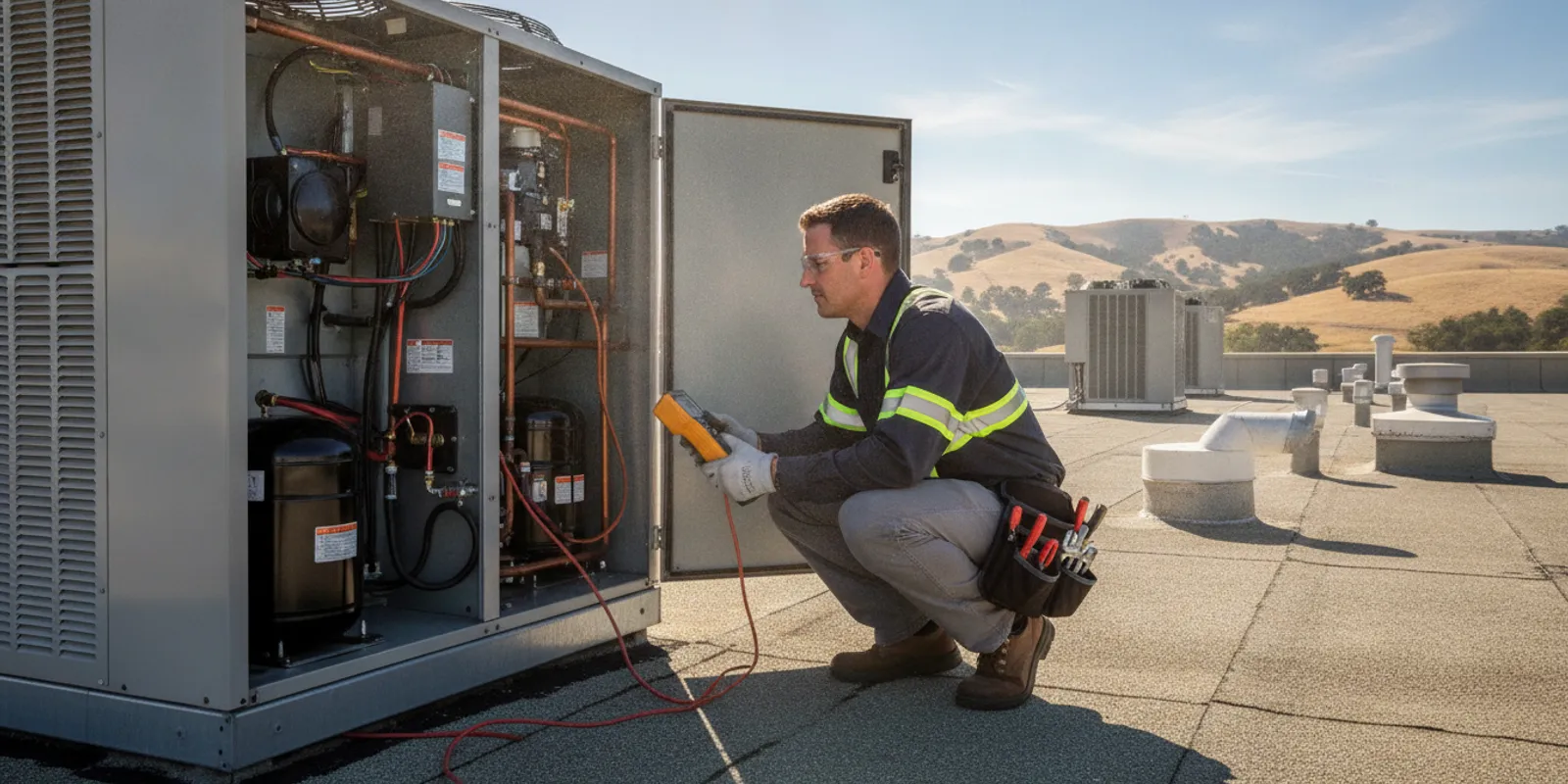
If you are asking how often should commercial HVAC be serviced, the practical answer depends on the building and the equipment, not one calendar rule. A useful schedule considers system type, operating hours, occupancy, seasonal demand, site conditions, service history, and the impact of an interruption. Use planned reviews before periods of heavier heating or cooling demand as a starting point, then refine timing with manufacturer instructions and findings from the site.
Discuss commercial HVAC service with Airteks
Call Airteks at (510) 719-0621
Why does commercial HVAC service frequency vary?
A small office used on a steady weekday schedule does not place the same demands on equipment as a school, restaurant, retail space, warehouse, or building that operates for extended hours. Even within one property, systems can serve different zones and have different workloads. One unit may cool a crowded area throughout the day, while another serves an infrequently used room.
That is why frequency is a planning decision rather than a universal date. These factors help explain why one building or unit may need a different review cadence from another:
- Equipment type and instructions: Rooftop units, split systems, heat pumps, boilers, and other equipment have different components and manufacturer guidance. Keep the model information and maintenance instructions available where possible.
- Operating hours: Longer or near-continuous run time adds exposure compared with a system used for a shorter, predictable schedule. Include evening, weekend, and seasonal operation in the picture.
- Occupancy and space use: A classroom, office, kitchen, retail floor, or storage area may have different comfort expectations, schedules, and operating needs.
- Conditions around the equipment: Dust, debris, kitchen activity, and other site conditions may affect how quickly equipment needs attention.
- Service history: Repeated calls or unresolved findings are reasons to review whether the existing schedule still fits.
- Consequences of an outage: Consider who relies on the space, what work would stop, and whether a failure would disrupt a scheduled activity.
For a broader look at upkeep, read Airteks' guide to HVAC maintenance. This article focuses on deciding how often to plan commercial service, rather than listing every maintenance task or describing a service agreement.
How often should commercial HVAC be serviced in practice?
Without details about the equipment and site, it would be misleading to prescribe an exact interval. Many facility teams plan a review ahead of the main heating and cooling seasons. That is a reasonable starting point for discussion, not a guarantee that every system needs the same number of visits or that a visit must happen on a particular date. Use the equipment manufacturer's maintenance instructions and applicable requirements as the baseline, then ask whether site conditions call for a different cadence.
A system operating for long hours, serving demanding spaces, or experiencing recurring problems may warrant closer or more targeted attention. A lightly used system with a stable history may have different needs. The point is to set timing based on a particular system's use and findings, rather than assuming that all units in a building should automatically be treated alike.
| Building or equipment situation | Scheduling approach to discuss | Information to review |
|---|---|---|
| Standard-hours office with stable use | Plan reviews around expected heating and cooling seasons | Operating hours, comfort reports, prior service findings |
| Long-hours or near-continuous operation | Ask whether shorter intervals between planned assessments make sense | Run time, recurring faults, workload, impact of downtime |
| School or high-occupancy facility | Coordinate access and timing with occupancy and calendar changes | Room schedules, comfort concerns, access windows, events |
| Kitchen or dusty environment | Review whether site conditions warrant closer attention | Debris exposure, equipment condition, previous observations |
| Older system or repeated service issues | Reassess in light of findings instead of relying only on a standard calendar | Repair pattern, open recommendations, reliability concerns |
This table is a framework for a service discussion, not a promise that any specific number of visits fits every property. A routine planned assessment and a response to a developing problem are different things. If equipment is showing symptoms, do not wait for the next seasonal review just because it appears on the calendar.
How do system type and operating hours affect timing?
Commercial buildings often have several systems that serve separate areas. A single interval may be convenient to administer, but it may not reflect each unit's demands. A rooftop unit serving a busy section may have a different workload from a lightly used or backup system. A heat pump may provide heating and cooling, and the way a building uses it affects its annual workload. Heating equipment such as boilers has its own components and instructions.
Start with an equipment inventory. It can be a simple spreadsheet or site list. For each system, record the location, the area it serves, its general type, and any available model or serial information. Note whether its normal operation follows the building's opening hours or continues outside them. If several units serve similar spaces, record that relationship rather than treating the building as one undifferentiated system.
Operating hours are useful, but they do not determine the plan by themselves. Two units can run for a similar number of hours while having different histories, conditions, and consequences if they stop. Record unusual periods of heavier use, such as extended school days, a seasonal business peak, or evening events. Also note a recent occupancy or control change that may have altered when a unit runs.
Airteks provides commercial HVAC services. A discussion about timing is more useful when it identifies system types, spaces served, hours, and known comfort or control issues. If heat pumps are part of the site, the page on commercial heat pump services is a related resource.
How should occupancy and building use shape a schedule?
Occupancy means more than the number of people in a building. It includes when people are present, whether that schedule changes, and how important stable conditions are in particular spaces. A classroom, office, retail floor, and production area may all have different priorities. A facility open to visitors or following a fixed calendar may also have limited windows for service access, which makes advance coordination useful.
Before settling on planned timing, ask the facility team:
- Which rooms or zones are most important to keep available and comfortable?
- When is the building least occupied, and can a technician access the relevant equipment then?
- Are there recurring hot or cold areas, and when do people notice them?
- Have opening hours, room use, or occupancy changed since the current schedule was set?
- Would a heating or cooling interruption affect essential operations or a scheduled event?
For a school, it may be practical to coordinate visits with calendar transitions, but do not assume that every system has identical needs. A school may have separate equipment serving classrooms, offices, and shared areas. Record when those areas are used and when access is easiest. Share recurring reports by room and time of day; that is more actionable than a general note that “the building is uncomfortable.” Airteks' experience includes school facilities, while an appropriate plan still depends on the building and equipment in question.
Changes in use deserve a fresh look even if no one has reported a fault. For example, if a previously quiet office area becomes a regularly occupied training room, the facility team can note the new schedule and report any resulting comfort concerns. That does not automatically determine a new maintenance interval, but it gives a technician practical context for considering whether the current plan remains suitable.
Why plan around seasonal transitions?
Seasonal planning gives a facility team time to review equipment before it is expected to carry more heating or cooling demand. Cooling systems can be assessed in advance of warmer weather, and heating systems before colder conditions arrive. The useful date varies by equipment, site, and local conditions. Northern California weather and seasonal transitions are not identical across the Bay Area, Central Valley, and Sacramento, so a calendar copied from another property may not fit yours.
Planning ahead can make coordination easier as well. The team can arrange access, gather previous reports, and raise non-urgent questions before a busy operating period. Keep this distinction clear: a seasonal visit is a planning opportunity, not a reason to defer a problem already affecting operation. If a system is struggling, behaving unusually, or failing to maintain expected conditions, seek an assessment rather than waiting for a scheduled date.
It can help to put a planning window on the facility calendar instead of relying on a reminder that says only “service HVAC.” Identify which systems are due for review, who will arrange access, and which previous findings need follow-up. Airteks serves commercial clients across Northern California, including the Bay Area, Central Valley, and Sacramento; its commercial service areas page provides location information.
What signs call for a schedule review?
Some circumstances are a reason to revisit the existing calendar. Repeated repair calls, uneven temperatures, unusual noise, an unexplained change in operation, or a system struggling during ordinary demand are useful signals to discuss. A symptom does not prove its cause, and it does not establish how often service should occur. It does mean that the previous plan may need to be considered alongside the new information.
Review timing after a change to the building or its operation, too. A new tenant, longer hours, a change in how a room is used, equipment replacement, or a different site condition can alter the context. Keep notes on when a concern began, which area it affects, and whether it appears at a particular time or under particular conditions. Those observations help a professional assess the situation without requiring facility staff to diagnose it.
For urgent HVAC issues, Airteks notes 24/7 emergency availability. An active outage or serious operating concern is not simply a question of routine frequency. For longer-term planning, review the system history and building needs so that any recurring concern can inform the schedule.
How can a facility team build a practical service calendar?
A useful calendar makes timing visible and ties it to actual building conditions. It does not need to be elaborate, and it should not add visits automatically. Start with what the team knows, mark what needs confirmation, and use the next service discussion to resolve gaps. The following sequence gives facility managers a repeatable way to organize that work.
- List the equipment. Record system type, location, served areas, and available model or service information. If you cannot identify a detail, mark it as unknown rather than guessing.
- Describe normal use. Add building hours, occupancy patterns, seasonal peaks, and access constraints. Distinguish normal operation from unusual events or extended schedules.
- Gather service history. Collect prior reports, repair dates, recurring symptoms, and recommendations that remain open. Note which system each report concerns.
- Flag high-impact areas. Identify spaces where loss of heating or cooling could disrupt operations, scheduled activities, or occupants' use of the building.
- Set review windows. Coordinate planned assessments with seasonal demand and the building schedule, guided by manufacturer instructions and professional advice.
- Revisit after changes. Update the plan when equipment, occupancy, hours, space use, or site conditions change, and after service findings raise a new question.
For example, imagine an office extends its hours and employees begin using one zone in the evening. The facility manager can update the unit's operating schedule, note any new comfort reports, and bring those observations to a service discussion. If the space remains comfortable and there are no new findings, that alone does not prove that more frequent service is necessary. If the unit now runs substantially longer or a recurring concern appears, the information gives the technician a concrete reason to assess whether timing should change.
Consider a school with repeated reports from one wing while other areas are stable. The team can record which rooms are affected, when the problem occurs, how many systems serve that area, and whether it coincides with occupancy or weather. A room-by-room log can help separate a localized concern from a building-wide pattern. That is more useful than increasing the frequency for every unit without understanding which equipment and conditions are involved.
A third example is a retail property that operates for longer hours during a busy season. Rather than wait for a complaint, the manager can share the changed schedule and expected peak period with the service provider. The discussion can consider whether a planned review should occur before that period, whether only certain systems need attention, and how to schedule work without disrupting access. The specific recommendation still depends on equipment instructions and site findings.
What should you prepare before discussing service frequency?
Facility teams do not need to diagnose equipment before asking for guidance. A concise site summary is a better starting point than a guess about the cause. Prepare the building location, system types if known, approximate operating hours, served spaces, and a plain description of recent issues. Mention changes in occupancy or use, and share service reports or equipment records when available.
It also helps to explain scheduling constraints. Note when rooms are occupied, whether access needs advance coordination, and which systems may need to be considered together. Ask how the proposed timing relates to the manufacturer's instructions, the operating environment, and prior findings. If a recommendation calls for closer follow-up on one system, ask what observation or risk is behind that recommendation and what would prompt another review.
When comparing options, look for an explanation tied to the property rather than a generic promise. A clear discussion should identify which equipment is included, what information informed the suggested timing, how exceptions will be handled, and when the plan should be reconsidered. Avoid confusing the number of planned assessments with a guarantee against breakdowns; maintenance planning cannot eliminate every equipment problem.
Airteks' guide to choosing a commercial HVAC contractor offers broader context for commercial service decisions. Teams discussing heating equipment can also review commercial heating services.
How do indoor conditions fit into HVAC planning?
Comfort and indoor conditions are part of the reason to tie service planning to how the building is used. The U.S. Environmental Protection Agency provides general information on indoor air quality. That resource is background information, not a system-specific service interval or a substitute for equipment instructions, professional assessment, or applicable requirements.
When occupants raise concerns, document where and when they occur rather than assuming the cause. A report limited to one room may differ from a building-wide pattern. Note whether the issue is present all day or only at certain times, and whether a recent change in use may be relevant. These observations help a qualified professional decide what to examine and whether the service plan needs revision.
Keep responsibilities clear. Facility staff can share schedules, access details, occupant observations, and service records. A qualified HVAC professional can review equipment and explain how findings relate to maintenance timing. Neither role needs to be replaced by a blanket calendar rule.
Ask Airteks about a commercial HVAC service schedule
Call Airteks at (510) 719-0621
Frequently Asked Questions
Is twice a year always enough for commercial HVAC?
Not necessarily. Seasonal reviews can be a practical starting point, but equipment type, run time, building use, condition, manufacturer instructions, and the impact of downtime all matter. Ask for timing based on the systems and site rather than treating a general interval as a rule.
Should every system in one building have the same interval?
No. Systems may have different workloads, spaces served, conditions, and histories. A plan can group equipment where appropriate while noting exceptions for units with heavier use or recurring concerns.
Does newer equipment need less attention?
Age alone does not determine frequency. Follow the manufacturer's instructions and consider operating conditions, use, and service findings. New equipment still needs care suitable to its type and application.
When should a facility team revisit its schedule?
Review the plan after a change in occupancy or operating hours, equipment replacement, recurring service problems, or a significant change in building use. Findings from planned visits can also show whether current timing remains appropriate.
Make service frequency fit the building
A useful commercial HVAC schedule reflects what the equipment does, how the building operates, and what an interruption would mean. Use seasonal planning as a starting point, then refine it with operating hours, occupancy, site conditions, manufacturer guidance, and service history. A discussion grounded in the actual building is more useful than applying one interval to every system.
Comments