
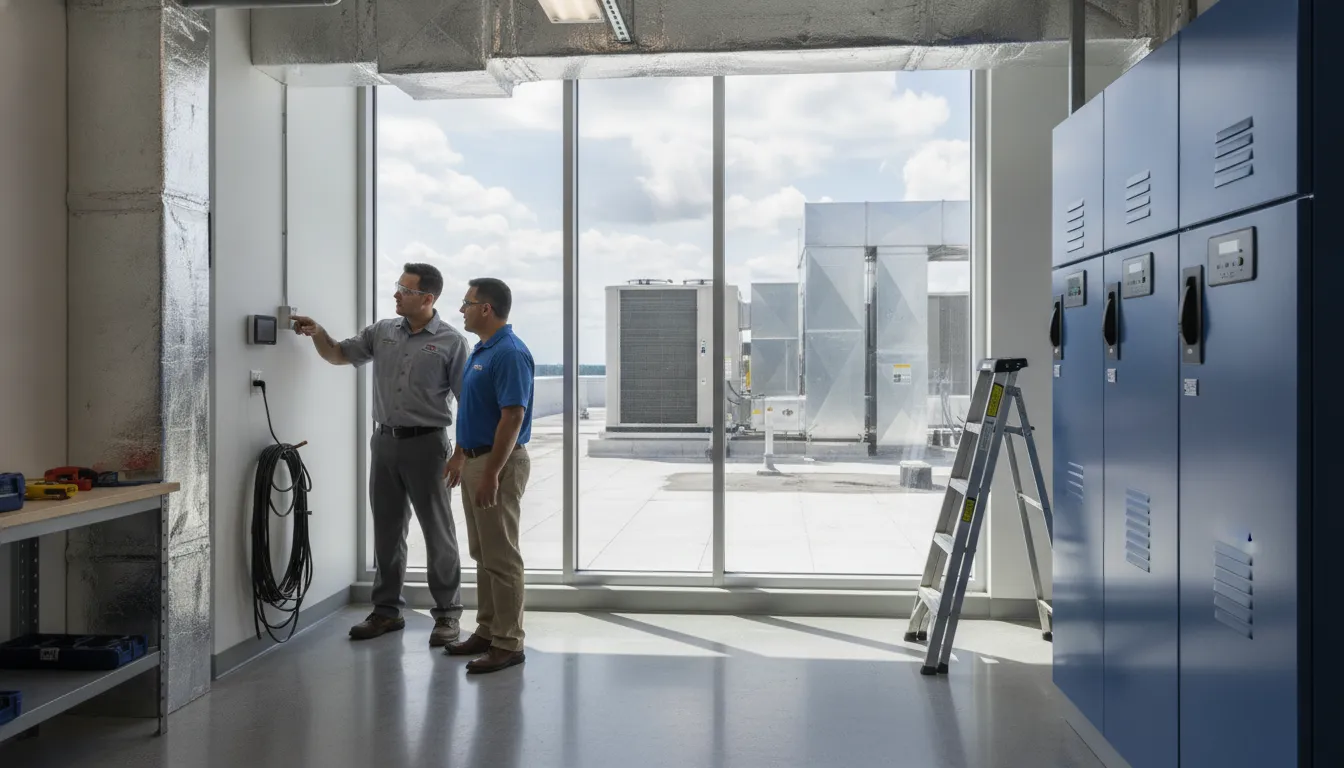
Choosing HVAC controls for a commercial building is not the same as choosing a thermostat for one home. A school, office, or retail site may need coordinated schedules, multiple zones, remote oversight, and dependable operation across changing occupancy.
Call Airteks at (925) 292-0148
Pelican wireless vs nest vs ecobee commercial comes down to building fit, not brand familiarity. Pelican is positioned specifically for commercial buildings, while Nest and Ecobee are familiar smart thermostat ecosystems that may suit some applications. The right choice depends on the existing HVAC equipment, number of zones, control requirements, network environment, and support plan.
Before comparing features, it helps to understand the difference between a connected thermostat and a broader control approach. Airteks explains that energy-efficient HVAC smart controls should be matched to how the building is occupied and operated, not selected from a feature list alone. That distinction starts with the system each platform was designed to manage.
What Is Pelican Wireless Designed For vs Smart Home Thermostats?
The key difference is architectural. A consumer-oriented smart thermostat typically focuses on controlling one comfort zone through an internet-connected thermostat, app, or website. A commercial controls platform is evaluated as part of a larger operating system for the building. That includes multiple zones, rooftop units or air handlers, schedules, user permissions, equipment coordination, and ongoing service.
That distinction matters because many smaller commercial buildings still have control gaps. The U.S. Department of Energy reports that more than 85 percent of commercial buildings, particularly small and medium-sized buildings, lack proper control infrastructure. It also identifies improperly configured setpoints, setbacks, schedules, and optimal-start sequences as common problems. A thermostat that can be adjusted remotely may be useful, but remote access alone does not solve every building-level control issue.
Pelican is built around commercial HVAC coordination
Pelican is described as designed specifically for commercial buildings, with a structure intended to connect field devices and give facility teams a broader view of distributed HVAC operation. Airteks describes its controls as cloud-based, allowing managers to manage HVAC equipment remotely and review energy or system performance. That can be practical for a facility manager responsible for several offices, retail locations, classrooms, or other zones rather than a single residence.
The wireless architecture is another important consideration. Airteks describes Pelican wireless mesh technology as connecting thermostats with zone coordinators. In a suitable application, that creates a path for organizing equipment by zone instead of treating every thermostat as an isolated device. Airteks also documents Pelican configurations such as the Z8, which can manage central equipment serving up to eight Pelican thermostats. And the Z24, which can manage central equipment serving up to 30. The correct configuration still depends on the equipment, wiring, zoning plan, and control sequence at the site.
How this changes the buying decision
For facility managers comparing pelican wireless vs nest vs ecobee commercial, the first question should not be which interface looks most familiar. Start with the building's control requirements. How many zones need independent schedules? Are multiple rooftop units operating without coordination? Does the team need centralized permissions, remote review, or a retrofit approach that works with existing equipment? These questions help separate a basic thermostat upgrade from a commercial controls project.
Airteks' energy-efficient HVAC smart controls guidance offers additional context. A qualified HVAC contractor can assess the equipment and sequences before recommending a platform. Helping the facility choose controls that fit its operational goals instead of adding disconnected devices.
Pelican Wireless vs Nest: Multi-Zone Commercial Control Comparison
For a commercial building, the important question is not which thermostat has the most familiar app. It is whether the control platform can coordinate the building's equipment, zones, schedules, users, and service requirements. A commercial HVAC provider describes Pelican as focused on commercial HVAC data transparency, while Nest and Ecobee are more commonly evaluated as smart thermostat platforms. That distinction is useful, but it is not a substitute for reviewing the actual building.
Pelican TS devices use a dedicated wireless mesh network to communicate with Pelican sensors and controllers, rather than relying on the building's standard Wi-Fi for that device communication. Pelican is also described as having tools for managing many devices through one interface and assigning user permissions. For larger air-handling-unit applications, a Pelican Zone Controller is described as supporting zoned control. These capabilities can matter when one facility has multiple rooftop units, air handlers, occupied zones, and people who need different levels of access.
| Consideration | Pelican Wireless | Nest | Ecobee |
|---|---|---|---|
| Communication and access | Dedicated mesh communication among Pelican devices; centralized management and permissions are described by commercial sources. | Current communication, account, and management options should be verified for the proposed commercial installation. | Current communication, account, and management options should be verified for the proposed commercial installation. |
| Multi-zone coordination | Zone Controller support is described for larger AHU systems with zoned control. | Confirm controller, equipment, and zoning support for the specific building. | Confirm controller, equipment, and zoning support for the specific building. |
| Operational fit | Designed specifically for commercial buildings, with a focus on HVAC data transparency. | Evaluate against the facility's operating model and control requirements. | Evaluate against the facility's operating model and control requirements. |
| Integration and APIs | A commercial comparison source states that all three platforms provide a programming API. Confirm current documentation and the required integration before selection. | ||
The need for this review is practical. The U.S. Department of Energy reports that buildings with multiple rooftop units may lack coordinated RTU operation. A thermostat change alone may not solve that control problem. Facility managers should map equipment, zones, schedules, network conditions, analytics needs, and user permissions before choosing a platform. Airteks can assess those requirements and explain how commercial Pelican Wireless systems may fit a retrofit or new control project.
Current Nest suitability must be verified against the building, equipment, and integration requirements. The same standard applies to Ecobee and Pelican. Product capabilities, compatibility, software services, and support models can change, so a qualified HVAC controls review should precede a purchasing decision.
Choosing Pelican Wireless vs Nest vs Ecobee Commercial Controls
Energy management depends on more than whether a thermostat offers an app. Facility teams should look at how a platform measures conditions, coordinates equipment, supports remote decisions, and connects with the rest of the building's control strategy.
Many smart thermostats use standard Wi-Fi and provide remote access to settings and schedules through an app or website. That can be useful for a small operation or a straightforward HVAC application. Ecobee may also support additional temperature or occupancy sensors, which can help measure conditions in a larger space more representatively than a single wall-mounted thermostat. These features should still be evaluated against the equipment and control sequence at each site. A commercial HVAC comparison from Trove describes Ecobee's commercial functionality as involving a supplemental service, rather than assuming the consumer thermostat alone provides every commercial control function.
Remote management is only one part of the decision
Pelican is described by Airteks as a cloud-based control platform that allows facility managers to manage distributed HVAC equipment and review energy or system performance remotely. Another commercial HVAC source describes Pelican as providing one interface for managing many devices and assigning user permissions. For a multi-zone office, retail location, or portfolio of buildings, those administrative details may matter as much as remote temperature adjustment.
Ecobee, Pelican, and Nest are all reported to provide a programming API, so integration potential should be part of the conversation. The existence of an API does not, by itself, prove that a platform will connect cleanly to a building automation system, analytics tool, or existing equipment. Ask the installing contractor to identify the specific integration path, data available, permissions model, and ongoing support responsibilities before purchase.
Check economizers, IAQ, and equipment coordination
Energy management also includes outside-air control, indoor air quality, schedules, and coordination among rooftop units. The U.S. Department of Energy reports that economizer controls often do not work as intended and that buildings with multiple rooftop units may lack coordinated operation. That is why a thermostat comparison should not be separated from a controls assessment. A system that adjusts setpoints but leaves ventilation sequences or equipment coordination unresolved may not address the building's largest operational issues.
DOE guidance connects modern digital control workflows with efficiency, indoor air quality, resilience, interoperability, fault detection, and energy analytics. Use that broader framework when comparing Pelican with Ecobee or Nest. Review the existing HVAC equipment, zone count, sensor locations, network requirements, ventilation strategy, and reporting needs. Then verify the proposed sequence in writing and confirm who will configure, commission, maintain, and troubleshoot it. For a deeper overview of energy-efficient HVAC smart controls, Airteks can help connect the product decision to the building's actual operating requirements.
Which System Is Best for Schools, Office Buildings, and Retail Spaces?
There is no responsible one-size-fits-all answer. The right commercial control platform depends on the building's equipment, number of zones, operating schedule, remote-management needs, and the team's ability to maintain and support it. A familiar thermostat may be appropriate for a small, straightforward application, while a distributed facility may need coordinated controls and a clearer view of system performance.
Schools: prioritize air quality, scheduling, and installation windows
Schools operate around bell schedules, occupied classrooms, athletic spaces, administrative offices, and seasonal breaks. Decision makers also have to balance indoor air quality, budget cycles, summer installation windows, and reliable operation. Those requirements deserve more weight than the appearance of an app or thermostat.
When a district has many zones or several pieces of central equipment, ask whether the proposed system can be mapped to the campus's actual control structure. Pelican's wireless mesh technology connects thermostats with zone coordinators. And Airteks describes the Z8 and Z24 as options for central equipment serving up to eight and up to 30 Pelican thermostats, respectively. That capacity does not automatically make Pelican the best choice, but it gives a school district a specific architecture to evaluate against its facilities plan. For more detail on school-district controls, review the dedicated installation guidance.
Office buildings: match control depth to tenant and zone complexity
Offices can combine open work areas, private rooms, conference spaces, server rooms, and areas with different occupancy patterns. Facility managers should compare how each option handles zone mapping, schedules, permissions, remote oversight, and integration with the existing HVAC equipment. Standard smart thermostats may provide convenient app or web-based scheduling, but compatibility and control depth must be verified for the specific equipment and use case.
Pelican is positioned as a retrofit-friendly option for distributed HVAC environments, including offices. Its cloud-based controls can allow remote management and performance review, while the mesh approach can reduce the need to treat every thermostat as an isolated device. The practical question is whether those capabilities solve a documented operating problem, such as inconsistent schedules or difficult access to multiple zones.
Retail spaces: protect comfort without disrupting operations
Retail locations often need dependable comfort during customer hours, controlled operation before opening and after closing, and minimal disruption during installation. A small store with one simple system may have different needs from a multi-location operator with varied equipment and remote oversight requirements. Compare Nest, Ecobee, and Pelican on the total implementation, not just the device: equipment compatibility, zoning, network requirements, user access, serviceability, and future expansion.
Airteks positions Pelican for distributed commercial and retail environments, but the recommendation should follow a site assessment. A qualified HVAC partner can map the equipment, confirm the control sequence. And explain what installation and ongoing support will involve before a property owner commits to a platform.
Why Airteks Recommends Pelican Wireless for Commercial and Institutional Buildings
Airteks does not recommend Pelican Wireless as a universal answer for every building. The recommendation is based on project fit. Facility managers and property owners need to balance comfort, operating costs, equipment uptime, and performance across multiple zones. Schools also have to account for indoor air quality, budget cycles, summer installation windows, and dependable operation. Those requirements call for more than choosing a familiar thermostat brand.
Pelican can be a practical fit when a building has distributed HVAC equipment and needs centralized visibility without replacing every piece of existing equipment. Airteks describes Pelican controls as cloud-based, allowing facility managers to manage distributed HVAC and review energy or system performance remotely. Its wireless mesh technology connects thermostats with zone coordinators. The Z8 can manage central equipment serving up to eight Pelican thermostats, while the Z24 can manage equipment serving up to 30. Actual capacity and compatibility still depend on the equipment, controls design, and site conditions.
That architecture can be useful in offices, retail locations, schools, and other commercial or institutional facilities where zones, equipment, and operating schedules vary. Airteks positions Pelican as a retrofit-friendly option for distributed HVAC environments. A retrofit should begin with an assessment of the existing units, wiring, zoning, ventilation requirements, and control objectives. A wireless approach is not a substitute for a sound system design.
The other reason Airteks recommends Pelican for selected projects is the implementation relationship. Airteks can support the process from commercial HVAC design and equipment review through installation, configuration, maintenance, and service. That matters when the control platform must be mapped to real schedules, occupancy patterns, and zone priorities rather than left with default settings. Ongoing support also gives facility teams a practical point of contact when equipment, schedules, or building use changes.
For a commercial or institutional project, Airteks can help compare the building's needs with the available control options, then plan an installation around operational constraints. Review the commercial Pelican Wireless systems available through Airteks, or explore its broader commercial HVAC services before deciding whether Pelican is the right fit.
Frequently Asked Questions
Is Pelican Wireless better than Nest or Ecobee for a commercial building?
There is no universal winner. Start with the building's equipment, zoning, network requirements, occupancy patterns, remote-management needs, and service plan. Pelican is described as purpose-built for commercial buildings, while Nest and Ecobee may fit selected applications but require project-level verification for controllers and commercial functionality. A controls review is more useful than choosing by thermostat brand alone.
Can these systems manage multiple zones or rooftop units?
They may, but the required architecture depends on the equipment and sequence of operation. Pelican sources describe wireless mesh communication, centralized device management, and a Zone Controller for larger air-handling-unit systems. The U.S. Department of Energy also notes that buildings with multiple rooftop units often lack coordinated operation, so confirm how the proposed system will coordinate equipment before approving it. Source: U.S. Department of Energy.
Do commercial smart thermostats require Wi-Fi?
Many smart thermostats use standard Wi-Fi for remote settings and schedules. Pelican is described by commercial HVAC sources as using a dedicated wireless mesh network for communication instead. That distinction can matter in a retrofit, but the final design should still address internet access, controls commissioning, cybersecurity, and what happens if connectivity is interrupted.
What should schools consider before selecting a system?
Schools should evaluate indoor air quality, budget timing, summer installation windows, reliable operation, equipment compatibility, and who will manage schedules after commissioning. Ask each bidder to document zoning, occupancy control, ventilation sequences, permissions, alarms, training, and ongoing service. A system that looks simple at the thermostat can still require careful engineering across classrooms, offices, and common areas.
Talk With Airteks About Commercial HVAC Controls
The right controls approach depends on your building, equipment, zoning, and day-to-day operating needs. Airteks can help you evaluate system fit, plan installation, and support reliable commercial HVAC performance. Call Airteks at (925) 292-0148 to discuss your facility and the next practical step.
Comments