
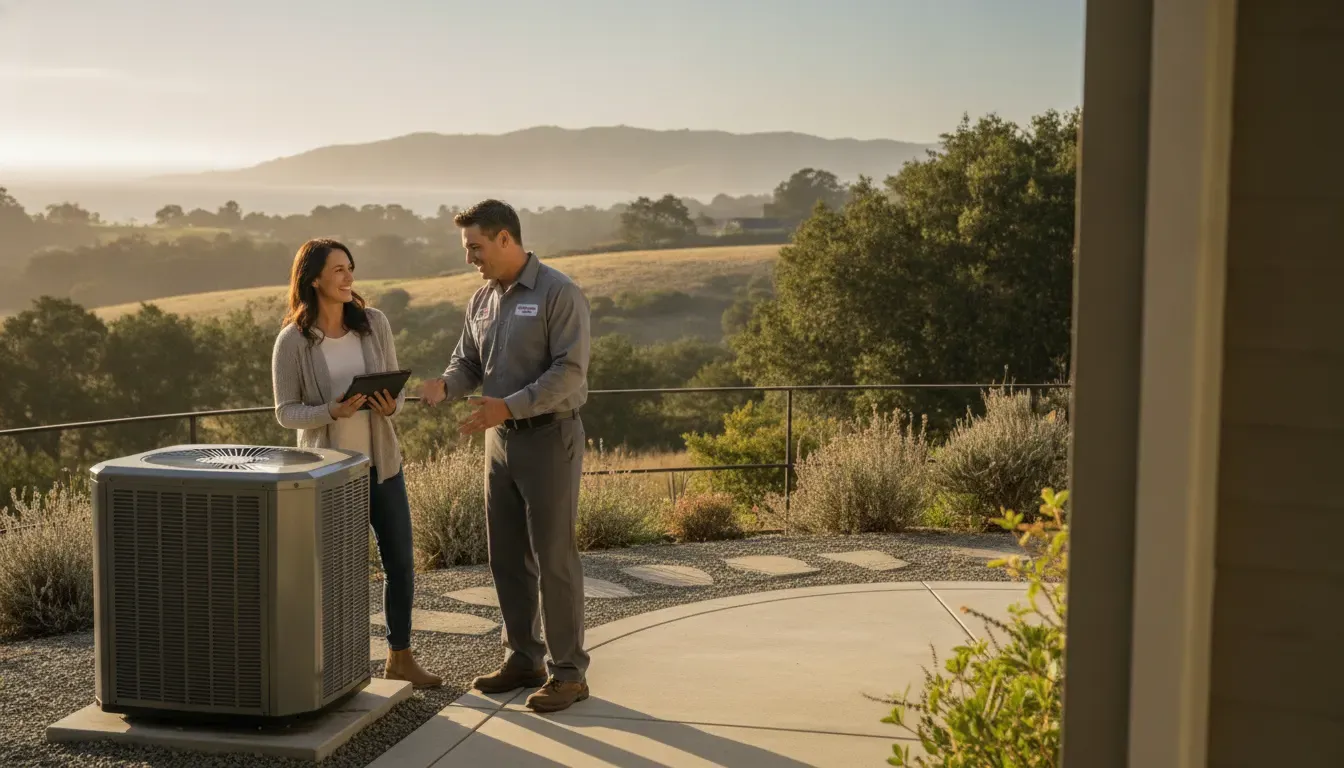
When homeowners ask about the most energy efficient HVAC system for a California home, the honest answer is not one model or brand. For many homes, a properly sized air-source heat pump is a leading all-electric choice because it can heat and cool with one system. The best fit still depends on your climate, ductwork, insulation, utility rates, and installation quality.
Call Airteks at (925) 292-0148 for a home-specific HVAC efficiency assessment.
For the broader planning picture, review this residential HVAC guide for Northern California. Then use the comparison below to narrow your options before requesting an equipment recommendation.
Heat Pump vs High-Efficiency Furnace vs Mini-Split: Efficiency Comparison
A properly sized, matched air-source heat pump is often the strongest all-season efficiency option for a California home that needs both heating and cooling. A high-efficiency furnace may fit a home that already has dependable gas service and a separate AC system. A ductless mini-split can be efficient for zones or homes without suitable ductwork.
An important distinction: a mini-split is usually a ductless configuration of a heat pump or air conditioner, not a separate efficiency category. Compare the complete system, not just the outdoor unit or a marketing label.
| System | Efficiency strength | Often fits | Questions to ask |
|---|---|---|---|
| Ducted air-source heat pump | One system can provide heating and cooling. It moves heat instead of creating heat by combustion. | Homes with usable forced-air ducts that want an all-electric replacement. | Are the ducts sized, sealed, insulated, and able to deliver the required airflow? |
| Ductless mini-split heat pump | Can avoid duct losses and condition selected zones. | Homes without ducts, additions, converted spaces, or rooms with different comfort needs. | Will the zone layout, controls, and outdoor unit capacity cover the whole home? |
| High-efficiency furnace plus central AC | Provides familiar gas heating and separate cooling, with AFUE and cooling ratings for comparison. | Homes with a good gas setup, suitable ducts, and a cooling system that is replaced separately or together. | What are the fuel costs, duct losses, equipment age, and future replacement plans? |
| Ground-source heat pump | Can use stable ground temperatures and may achieve high efficiency. | Properties with suitable land, long ownership horizons, and a project that supports site work. | Are the site, drilling or trenching, permits, and project cost practical? |
Airteks provides residential heat pump installation and maintenance, along with furnace, central AC, and ductless services. A home assessment should compare the existing equipment, design load, duct condition, electrical service, comfort goals, and expected usage. For a complete system-selection framework, return to the Northern California residential HVAC guide.
What Does SEER and HSPF Mean in Real Energy Savings?
SEER2 measures seasonal cooling efficiency, while HSPF2 measures seasonal heating efficiency for a heat pump. Higher ratings can indicate better tested performance, but neither rating predicts a specific California utility bill. Compare the matched indoor and outdoor system, capacity, operating conditions, and installation, not a number in isolation.
ENERGY STAR defines SEER2 as seasonal cooling output divided by electrical energy used during the test procedure. HSPF2 applies the same basic idea to seasonal heating output. The current ENERGY STAR heat pump criteria list certification thresholds by system type, including different requirements for split, package, and cold-climate equipment.
Use these ratings as part of a short buying checklist:
- Ask for the exact matched system combination, not just the outdoor unit rating.
- Compare SEER2 for cooling and HSPF2 for heat pump heating.
- Ask whether the system also has an appropriate EER2 rating for specified hot-weather conditions.
- Request a room-by-room load calculation so the equipment is not oversized.
- Have the installer evaluate duct leakage, insulation, airflow, and return-air capacity.
- Confirm refrigerant charge, controls, drainage, electrical capacity, and commissioning steps.
ENERGY STAR explains that an air-source heat pump can deliver up to about three times more heat energy than the electrical energy it consumes under stated conditions. That technical ratio is not a promise that every homeowner will see a specific percentage reduction. Household results also reflect weather, thermostat settings, building envelope, utility rates, and the system being replaced.
For the cooling side of the decision, Airteks also provides residential air conditioning services, including installation and replacement guidance. The right comparison may be a heat pump against a new AC and furnace, not a heat pump against an old unit with unknown performance.
How Much Can You Save on Utility Bills With a High-Efficiency System in California?
There is no responsible single savings figure for every California home. Estimate savings by comparing the same weather and comfort needs under local electricity and gas rates, then account for equipment efficiency, operating hours, duct losses, maintenance, and the system being replaced. A contractor should show the assumptions behind any estimate.
A simple comparison starts with the inputs:
- Review recent heating and cooling usage, not just the total household bill.
- Record your utility's current electricity and natural-gas rates, including time-of-use considerations when relevant.
- Identify whether the replacement serves heating, cooling, or both.
- Check the age, condition, capacity, and measured performance of the existing system.
- Evaluate insulation, air leaks, duct sealing, and thermostat settings before choosing larger equipment.
- Compare the expected operating profile with installation, maintenance, and any verified incentive assumptions.
The commonly repeated 5,000 rule is only a repair-versus-replace rule of thumb, not an official HVAC standard. It multiplies system age by the estimated repair cost. Use it as a prompt to compare options, then consider safety, repeat failures, parts availability, remaining service life, efficiency, and the condition of the entire system.
Airteks does not publish a one-size-fits-all installation price because each home's scope is different. A clear quote should identify equipment, duct or electrical work, permits, controls, testing, and the assumptions used to discuss operating costs. Avoid treating a higher efficiency rating as proof of a guaranteed payback.
California Utility Rebates for Energy-Efficient HVAC Upgrades
California rebates may reduce the cost of an eligible HVAC upgrade, but availability depends on the utility territory, household income, equipment, installation date, documentation, and remaining program funds. Confirm the live program rules before buying equipment. A rebate should be treated as a possible project factor, not as guaranteed savings.
The California Energy Commission reports that single-family HEEHRA rebates were fully reserved statewide as of February 24, 2026, and that new income-verification applications were no longer being accepted at that time. Unapproved reservation requests were placed on a waitlist. Historical maximums should not be advertised as currently available.
Before relying on an incentive, verify:
- Your electric or gas utility and the program's current service territory.
- Whether the program is open for new applications and has funds remaining.
- Income, residence, equipment, efficiency, and refrigerant requirements.
- Whether preapproval or reservation is required before purchase or installation.
- Which documents, model numbers, contractor qualifications, and inspections are required.
Use the California Energy Commission rebate guidance as a starting point, then confirm details with the current program administrator. California's HVAC Energy Code guidance is also relevant to new construction, additions, and alterations. It should not be read as a blanket requirement that every existing home install the same type of system.
Which System Is Most Efficient for the Bay Area vs Central Valley Climate?
Bay Area and Central Valley homes can need different HVAC designs even when they have the same square footage. Mild coastal conditions may favor a heat pump with careful low-load sizing, while hotter inland summers can make cooling capacity, airflow, duct condition, and hot-weather performance more important. Sacramento and nearby communities also need a heating plan for winter conditions.
For Bay Area homes, consider:
- A ducted heat pump when existing ducts are in good condition and the home needs both heating and cooling.
- A ductless mini-split when ducts are absent, difficult to extend, or creating zone problems.
- Humidity, ventilation, outdoor-unit placement, and low-load cycling during milder weather.
For Central Valley and Sacramento homes, consider:
- Cooling capacity and EER2 or other applicable hot-condition data, not only seasonal SEER2.
- Heat pump capacity at the outdoor temperatures used for the home's design.
- Electrical service, backup heat strategy, airflow, duct sealing, and attic or wall insulation.
- Controls that match the home's occupancy and comfort zones.
The California Energy Commission climate-zone resources can help frame the local context, but a home-specific load calculation is still needed. Airteks serves homeowners across Livermore, Pleasanton, Walnut Creek, Sacramento, the Central Valley, and surrounding Northern California communities. Its residential HVAC maintenance service can also help protect efficiency after installation.
In short, a correctly sized and installed heat pump is a strong candidate for many California homes, especially when one system must provide both heating and cooling. A high-efficiency furnace, ductless system, or ground-source system may be the better fit under different site, fuel, duct, or budget conditions. The best choice is the one that performs well in the home, not the one with the largest rating on a product sheet.
Frequently Asked Questions
What is the most energy-efficient HVAC system for a home?
There is no universal winner. For many California homes, a properly sized air-source heat pump is a leading all-electric option for heating and cooling. Ducted models can fit homes with usable ducts, while ductless mini-splits can fit homes without practical ductwork. Climate, load, rates, equipment matching, and installation quality still decide the result.
What is the 5,000 rule for HVAC?
The 5,000 rule is a repair-versus-replace rule of thumb, not an official HVAC standard. Multiply the system's age by the estimated repair cost, then use the result as one discussion point. Also consider safety, repeat repairs, parts availability, remaining life, efficiency, replacement scope, and a professional diagnosis.
Does California have a rebate for energy-efficient HVAC systems?
California may have utility or state incentive programs, but eligibility and funding change. The California Energy Commission reported that single-family HEEHRA rebates were fully reserved statewide as of February 24, 2026, with no new income verifications accepted at that time. Check the current official program page before ordering equipment or assuming a rebate.
What AC brands should homeowners stay away from?
A brand blacklist is not a reliable way to choose an efficient system. Compare the exact matched equipment, current certification, capacity, warranty, local parts support, sound level, and installer quality. Ask who will verify sizing, airflow, refrigerant charge, duct performance, controls, and commissioning after the installation.
Call Airteks at (925) 292-0148 for an honest recommendation and a home-specific HVAC quote. You can also contact Airteks online to discuss installation, replacement, heat pump, furnace, AC, or ductless service across Northern California.
Comments