
California homes face a changing mix of indoor and outdoor air concerns. Wildfire smoke, dust, pollen, vehicle emissions, and industrial activity can all affect the air entering or circulating through a Northern California home. Your HVAC system can help, but the right approach depends on the equipment, the pollutant source, and the home's ventilation needs.
To improve indoor air quality california home hvac systems should combine practical source control, properly maintained filtration, and appropriate ventilation or air cleaning. The U.S. Environmental Protection Agency identifies these as core strategies for improving indoor air quality, rather than relying on one filter or add-on device alone.
Call Airteks at (925) 292-0148
A useful starting point is understanding how local outdoor conditions interact with the way your home moves and filters air. For broader guidance on equipment and care, see Airteks' Residential HVAC Guide for Northern California, then consider why California's air environment deserves a closer look.
Why Improve Indoor Air Quality in a California Home With HVAC?
Homes across Northern California can face changing outdoor conditions throughout the year. Wildfires, wind-blown dust, pollen, motor vehicles, and industrial or commercial activity can all contribute to indoor air pollution, according to the California Air Resources Board. When outdoor air quality shifts, the way a home handles airflow becomes an important part of maintaining a comfortable indoor environment.
That does not mean every home needs the same equipment. The right approach depends on the pollution source, the home's construction, the existing HVAC system, and how air moves through the building. A practical plan starts by understanding three strategies identified by the U.S. Environmental Protection Agency: source control, improved ventilation, and air cleaners or filtration.
Start with source control
Source control means reducing pollutants where they originate. That may involve limiting the introduction of outdoor air during a smoke event, addressing dust entry, or managing activities inside the home that add particles or odors. This step matters because filtration works better when the system is not continually dealing with an avoidable source.
It is also the most direct place to begin an indoor-air-quality review. Before adding a new device, consider what is entering the home, where it enters, and whether the source can be reduced. This keeps the solution focused instead of treating every air-quality concern as an equipment problem.
Understand what ventilation does
Ventilation replaces or dilutes indoor air, but many homeowners assume their heating and cooling system automatically brings in fresh outdoor air. The EPA notes that most residential forced-air heating and air-conditioning systems do not mechanically bring outdoor air into the house. Air can enter naturally, through mechanical systems, or through infiltration around the building envelope.
That distinction is especially useful when evaluating how to improve indoor air quality in a California home with HVAC. Running a central system may circulate and filter indoor air, but it is not necessarily a dedicated fresh-air strategy. During periods of poor outdoor air quality, ventilation choices also need careful consideration rather than a blanket instruction to bring in more outside air.
For many Northern California homeowners, the best path is a balanced assessment of sources, airflow, and filtration. A qualified HVAC professional can help identify whether the existing system supports the home's needs and which improvements make sense without promising a one-size-fits-all result.
How HVAC Filters Affect Indoor Air Quality
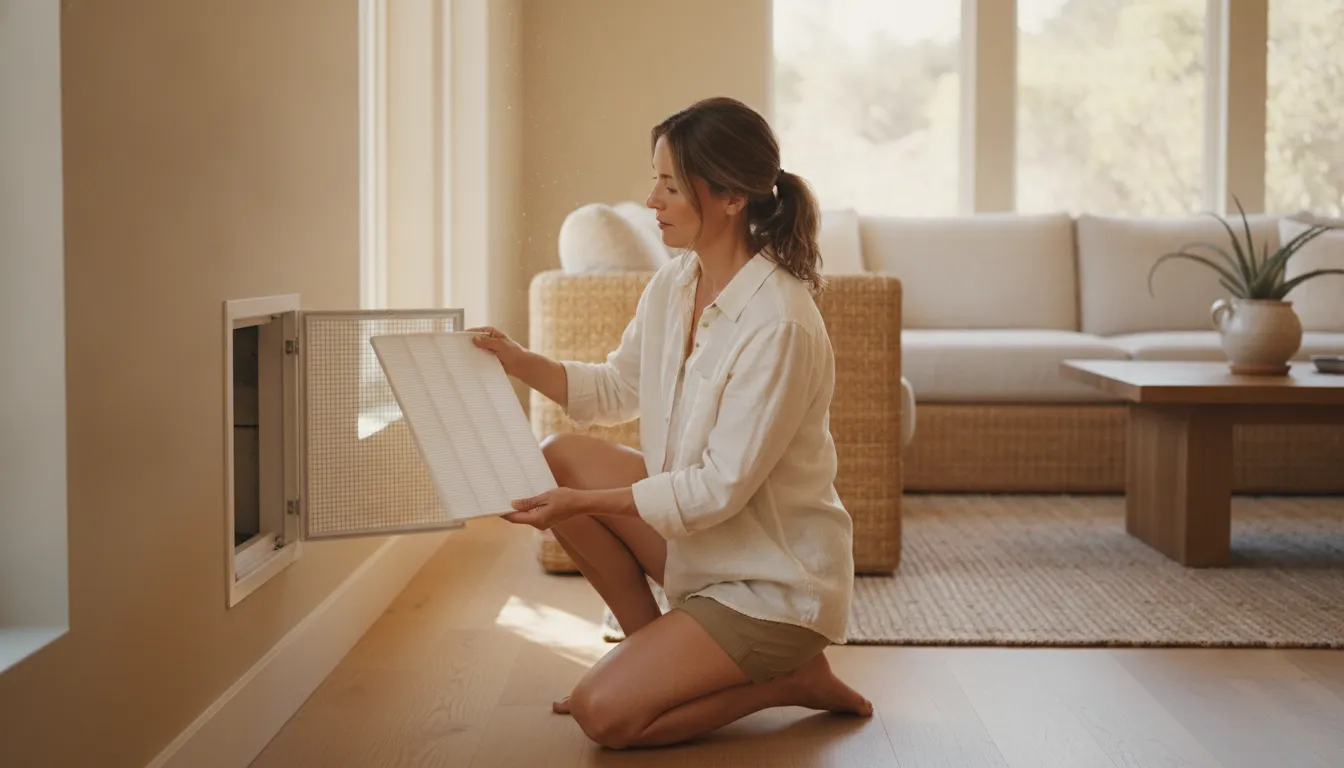
Your HVAC filter is one of the simplest parts of the system. But it plays an important role in how much airborne dust and other particles circulate through your home. The right filter can support a cleaner, more comfortable indoor environment. It cannot solve every air-quality problem, however. Results depend on the filter, the equipment, the condition of the ductwork, and the source of the pollution.
Start with fit, not just filter rating
A filter should fit securely in its intended slot, with the airflow arrow pointed in the correct direction. Gaps around the frame can allow air to bypass the filter, while a filter that is too thick may not fit properly or may restrict airflow. Check the size recommended for your system rather than assuming a higher-rated or thicker filter is automatically better.
Pleated filters are a practical starting point for many homes. The CDC recommends using a pleated filter in HVAC systems that have filters. If you are trying to improve indoor air quality in a California home with HVAC, start with the pollutants your household encounters. Consider seasonal dust, pollen, and wildfire smoke. Then match the filtration choice to your equipment and needs.
Replace filters on a dependable schedule
A loaded filter has less open surface area for air to pass through. It may also make the system work harder and reduce airflow. The CDC advises changing a home HVAC filter every three months, but the best schedule can vary with filter type, pets, construction dust, occupancy, and local conditions. Inspect the filter regularly, especially during smoky or dusty periods, and replace it when it is visibly loaded or according to the manufacturer's guidance.
Routine checks are a useful part of residential HVAC maintenance. A technician can also check whether the filter cabinet seals correctly and whether airflow appears appropriate for the system.
Use the fan setting thoughtfully
When appropriate, the CDC says a central HVAC fan with a filter can be set to "on" instead of "auto" when visitors are present. So air passes through the filter more consistently. Continuous fan operation is not right for every home or system. It can affect comfort, energy use, and humidity, so follow the equipment manufacturer's guidance and ask a professional when unsure.
Know when to add portable filtration
Portable HEPA cleaners are another option identified by the CDC. The EPA notes that residential air cleaners range from tabletop units to whole-house systems. A portable unit may be useful in a specific occupied room, while a whole-house approach requires equipment and ductwork compatibility. Higher-resistance filtration should receive professional review before installation, because restricting airflow can create operating problems. A qualified evaluation helps balance filtration goals with safe, reliable HVAC performance.
Air Purifiers, UV Lights, and HEPA Filters: What Works Best?
There is no single indoor-air-quality device that addresses every pollutant in a Northern California home. The right choice depends on whether the main concern is a pollution source, airborne particles, stale air, or a need for more controlled ventilation. The U.S. Environmental Protection Agency groups the basic strategies into source control, improved ventilation, and air cleaners or filtration. In practice, those strategies work best together rather than as competing choices.
Start by reducing the source when possible. For example, avoid bringing smoky outdoor air inside during a wildfire event, control dust during remodeling, and use exhaust ventilation for activities that create moisture or odors. EPA describes source control as usually the most effective approach. An air cleaner cannot replace removing or reducing a pollutant at its origin.
| Option | Best fit | Important limitation |
|---|---|---|
| HVAC filtration | Routine filtration through a central forced-air system | Filter selection, fit, airflow, and timely replacement all matter. A filter is not a substitute for source control. |
| Portable HEPA cleaner | A targeted room or area where portable filtration is practical | It serves the space where it is placed. It does not automatically provide whole-home coverage or fresh outdoor air. |
| Whole-house air cleaner | Filtration integrated with a home's HVAC equipment | Compatibility and airflow need to be evaluated before installation. EPA notes that air cleaners range from tabletop units to whole-house systems. |
| UV light | A component considered as part of a professionally designed HVAC strategy | UV is not a universal particle filter. It should not be presented as a replacement for filtration, source control, or ventilation, and the equipment's design and installation matter. |
| Mechanical ventilation | Homes that need controlled outdoor-air exchange, including filtered ventilation designs | Outdoor air quality and system design must be considered. Most residential forced-air heating and cooling systems do not mechanically bring outdoor air indoors. |
For filtration, the CDC recommends using a pleated filter in HVAC systems that have filters and changing it every three months. The CDC also identifies portable HEPA cleaners as an option. A qualified HVAC professional can check whether the filter is installed correctly. Whether the equipment can support the selected filter, and whether a whole-house solution makes sense for the home's layout.
Ventilation requires equal care. EPA notes that air enters homes through natural ventilation, mechanical means, and infiltration, while some mechanical systems use heat recovery ventilators. During recurring outdoor pollution, California guidance supports considering filtered mechanical ventilation. During a short-term smoke episode, follow current official guidance before using outdoor-air or exhaust equipment, and never disable combustion-safety equipment.
How Wildfire Smoke Affects HVAC and What to Do
Wildfire smoke can enter a California home through open doors and windows, exhaust pathways, and small leaks in the building envelope. Your HVAC system can help manage indoor particles when its filter and operating settings are appropriate, but it cannot make every outdoor-air decision for you. Use this short-term response when smoke conditions change:
- Check outdoor air quality before bringing in outside air. The CDC generally recommends bringing fresh outdoor air indoors when possible, including by opening windows or using exhaust fans. During wildfire smoke, however, first check current local air-quality conditions and official guidance. If outdoor air is heavily polluted, opening windows or running exhaust fans may bring more smoke inside. The CDC's air-quality guidance can help you evaluate when outside air is appropriate.
- Reduce openings and indoor smoke sources. Keep windows and exterior doors closed when smoke is elevated, and avoid adding particles indoors through activities such as burning candles or using a fireplace. The EPA identifies eliminating pollution sources or reducing their emissions as usually the most effective indoor-air-quality strategy. Review the EPA's indoor-air-quality guidance for broader source-control principles.
- Adjust ventilation carefully. For a short-term outdoor-pollution episode, the California Air Resources Board says turning off mechanical ventilation equipment and exhaust fans can reduce outdoor-pollutant penetration. That is not a blanket instruction for every home or system. Follow current official local guidance, and never disable carbon-monoxide alarms, combustion-safety equipment, or other life-safety devices. If smoke returns regularly, CARB says a permanent mechanical ventilation system that provides filtered outdoor air should be considered.
- Keep filtration working. Confirm that your HVAC filter is correctly installed, seated tightly, and not overdue for replacement. A filter that is loaded with debris or fitted incorrectly can limit airflow. If your system is designed for it, a portable HEPA cleaner may provide an additional filtration option in an occupied room. Avoid forcing a thicker or higher-resistance filter into equipment that was not designed to handle it.
- Arrange an HVAC assessment when smoke exposure keeps recurring. Repeated smoke events may justify reviewing filter fit, airflow, ventilation controls, duct leakage, and equipment capacity together. A qualified technician can recommend a practical approach for your home instead of treating one product as a universal fix. Smoke-related odor or visible residue that persists after conditions improve is also a reason to request an evaluation.
Wildfire smoke response should always remain secondary to evacuation orders, fire-department instructions, and other official safety guidance. HVAC adjustments can support source control and filtration, but they do not replace emergency precautions.
HVAC Upgrades That Improve Air Quality in Northern California Homes
The right upgrade starts with an assessment, not a product list. An HVAC professional can review equipment condition, airflow, duct leakage, filtration, ventilation, and the home's comfort patterns. That evaluation helps identify whether the main opportunity is controlling incoming pollutants, improving distribution, replacing an aging system, or addressing several issues together. Airteks provides residential HVAC services, including installation, repair, replacement, and maintenance.
Ductwork deserves particular attention. Leaky or poorly insulated ducts can allow unwanted air into the system and reduce the amount of conditioned, filtered air reaching living spaces. Airteks' duct sealing and insulation work is designed to address air leakage in Northern California homes and buildings. Sealing problem areas and improving insulation can also help the system distribute air more consistently.
Match the replacement system to the home
If replacement is appropriate, proper sizing and configuration matter. Airteks notes that AC installation includes sizing and configuration for efficient operation. An oversized or poorly matched system may not condition the home evenly, while an undersized system can struggle during demanding weather. The assessment should account for the home's layout, insulation, existing ductwork, and local climate rather than relying only on the old equipment's capacity.
Ventilation is another important part of the conversation. Most residential forced-air heating and cooling systems do not mechanically bring outdoor air into a home. A dedicated mechanical ventilation design, potentially using a heat recovery ventilator, can provide a more deliberate approach where fresh-air exchange is needed. In homes near recurring outdoor pollution, filtered ventilation may be worth evaluating alongside source control and filtration.
Consider the equipment that fits your layout
Heat pumps provide year-round heating and cooling, and Airteks services their repair, installation, maintenance, and replacement. Furnaces remain another option, with services covering inspection, repair, maintenance, upgrades, installation, and replacement. For homes without ductwork, or rooms needing targeted conditioning, ductless mini-split systems can be a practical alternative. Each system still requires appropriate filtration, airflow planning, and regular maintenance to support indoor comfort.
For a broader planning framework, review the Residential HVAC Guide for Northern California. Airteks technicians are factory-certified, licensed, insured, and experienced across makes and models, which supports a careful assessment before recommending an upgrade.
Call Airteks at (925) 292-0148
Frequently Asked Questions
What can I add to my HVAC system to improve air quality?
Start with the pollutant source and your system's capacity. A properly fitted pleated filter is a practical first step. The CDC recommends changing a home HVAC filter every three months, although dusty conditions and household use may require more frequent checks. A portable HEPA cleaner can supplement central filtration in a particular room. Whole-house air cleaners and filtered mechanical ventilation are other options, but they should be selected to match the equipment, ductwork, and ventilation needs of the home. CDC guidance identifies pleated filters and portable HEPA cleaners as options.
How does HVAC affect indoor air quality?
Heating and air-conditioning equipment moves air through the home, and its filter can capture some airborne particles. However, most residential forced-air heating and cooling systems do not mechanically bring fresh outdoor air indoors, according to the EPA. That means improving air quality may require more than changing a filter. Source control, appropriate ventilation, filtration, humidity management, and duct inspection each address a different part of the problem.
How can I improve poor indoor air quality during California wildfires?
First, limit indoor pollutant sources and check local outdoor air-quality guidance before opening windows or running exhaust fans. During a short-term pollution episode, the California Air Resources Board says turning off mechanical ventilation and exhaust fans can reduce outdoor pollutant entry. Never disable equipment needed for combustion safety. For recurring outdoor pollution, consider professionally designed mechanical ventilation that provides filtered outdoor air. Keep doors and windows closed when outdoor smoke is heavy, and use suitable filtration for your system.
How often should my HVAC system be checked for indoor air quality problems?
Check the filter regularly and arrange preventive maintenance at least annually. Airteks recommends annual preventive AC maintenance, ideally in spring before peak cooling season. A professional can also evaluate airflow, filter fit, duct leakage, equipment condition, and whether an upgrade is appropriate for your home. Maintenance will not replace source control, but reliable equipment and sealed ductwork can support consistent comfort and cleaner indoor air.
Ready to Improve Your Home's Indoor Air Quality?
Indoor air quality solutions work best when they match your home's equipment, ductwork, ventilation needs, and the pollutants you are trying to manage. Airteks can help you discuss practical options for filtration, ventilation, ductwork, maintenance, or HVAC service in Northern California.
Comments