
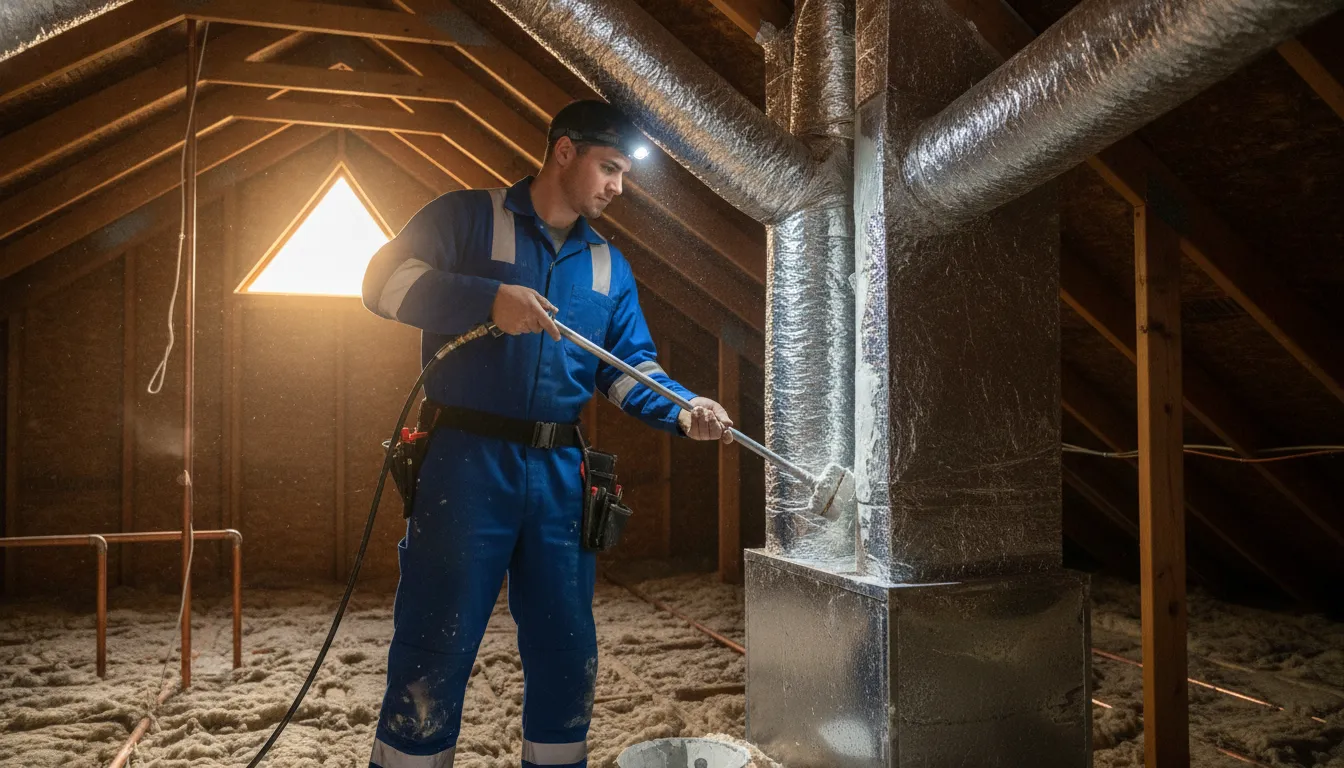
In Northern California, a comfortable room can still hide an inefficient HVAC system. Ducts running through attics, crawlspaces, or other unconditioned areas may lose heat, gain heat, or leak conditioned air before it reaches the rooms you use.
Duct sealing insulation hvac efficiency northern california are closely connected: sealing leaks keeps conditioned air inside the system. While properly rated insulation helps limit heat transfer through duct walls. Together, these improvements can support steadier comfort and reduce unnecessary equipment workload.
A professional inspection can show whether leakage, inadequate insulation, or both are driving uneven temperatures and higher energy use.
Call (925) 292-0148 to schedule your duct inspection.
Duct performance also fits into a broader plan for smart HVAC controls for energy efficiency. The first step is understanding how much energy a leaking system may waste.
How Much Energy Does Duct Leakage Waste in a California Home?
Duct leakage wastes energy in two connected ways: conditioned air escapes before it reaches the rooms. And the remaining air gains or loses heat while traveling through unconditioned spaces. In a Northern California home, that problem is especially noticeable when attic temperatures climb during summer or when exposed ductwork runs through a cool crawlspace in winter.
Conditioned air leaves the system before it reaches you
Supply ducts are supposed to deliver heated or cooled air to living spaces. Gaps at connections, damaged flexible duct, loose registers, and poorly sealed seams can release that air into an attic, crawlspace, wall cavity, or other unconditioned area. The U.S. Department of Energy notes that ducts can lose roughly 20% to 30% of conditioned air through leaks. That means the HVAC system may run longer while less of its work benefits the people inside the home.
Attic heat makes cooling losses worse
Air leakage is different from thermal loss, and a duct system can suffer from both at once. When ducts are inadequately insulated in an attic or crawlspace, heat can move through the duct walls as air travels toward the rooms. The Building Science Education Center explains that missing or inadequate insulation can cause significant heat gain or loss in unconditioned spaces. In a hot Northern California attic, cooled air can absorb heat before it reaches a bedroom or living area.
Equipment works harder to recover comfort
Longer run times increase electricity or fuel use and can make rooms feel uneven. ENERGY STAR identifies duct sealing as an efficiency measure that can improve HVAC performance, with leaky ducts reducing efficiency by as much as 20%. The actual impact depends on the duct layout, leak locations, insulation, equipment, and operating conditions. So a home assessment is more useful than assuming every household loses the same amount.
Insulation protects the air after leaks are addressed
Sealing stops unwanted air escape, while insulation slows heat transfer through the duct walls. For ducts in unconditioned spaces, the Building Science Education Center cites an ENERGY STAR minimum of R-8 insulation. High-R insulation with an appropriate vapor barrier also helps limit condensation on duct surfaces. A qualified professional can inspect the supply and return sides, identify leakage, and determine whether sealing, insulation, or both are appropriate for the home.
The practical result is straightforward: duct sealing and insulation can help more of the HVAC system's output reach the rooms that need it. Improving comfort while reducing avoidable energy waste. Source: Building Science Education Center and ENERGY STAR.
Signs Your Ductwork Needs Sealing or Insulation
Duct problems are often easy to notice in the rooms you use every day, even when the damaged section is hidden in an attic, crawlspace, wall, or ceiling. Pay attention to changes in comfort, airflow, moisture, and indoor air quality. A single symptom may have another cause, but several signs together justify a professional ductwork inspection.
- Some rooms will not stay the same temperature. If one bedroom remains warm while the living room cools normally. Or an upstairs area is consistently too hot or cold, air may be escaping before it reaches that register. Leaks, disconnected sections, crushed flex duct, or inadequate insulation can all contribute to uneven heating and cooling. The U.S. Department of Energy notes that duct design affects both the cost and effectiveness of heating and cooling a home: learn more about residential duct systems.
- You see condensation, sweating, or moisture around a duct. Damp duct surfaces are not a normal sign to ignore. When metal ductwork runs through an unconditioned space, insufficient insulation can allow the surface temperature to fall below the surrounding air's dew point. High-R insulation with a vapor barrier helps reduce heat transfer and prevent condensation, according to the U.S. Department of Energy Building Science Education and Solutions Center. Moisture can also damage nearby insulation or building materials, so identify the source before covering it.
- Your energy bills are higher than expected. A sudden or unexplained increase in heating or cooling costs can indicate that conditioned air is leaking into an attic or crawlspace. Or that poorly insulated ducts are gaining or losing heat along the way. The system may run longer to compensate, increasing fan and equipment workload. Compare bills across similar weather periods, and note whether longer run times or comfort complaints appeared at the same time.
- You notice dust, stale air, or odors when the system runs. Leaking return-side ductwork can draw air from unconditioned areas. That air may carry dust, insulation fibers, or other pollutants into the circulation path. The Department of Energy explains that duct systems can affect occupant health through the distribution of indoor air pollution. Do not assume cleaning alone will solve the problem. The EPA recommends duct cleaning when there is substantial visible mold inside hard-surface ducts or on HVAC components, rather than as a routine fix for every comfort complaint: review the EPA guidance.
- Airflow differs noticeably from register to register. A weak supply register, whistling grille, or large difference in airflow between similar rooms can point to a leak, restriction, disconnected branch, or supply-and-return imbalance. Check that registers are open and unobstructed, but avoid sealing or altering hidden ductwork without testing. Qualified inspection can distinguish a duct issue from a filter, blower, zoning, or equipment problem.
These symptoms do not automatically mean the entire system needs replacement. A leakage test and visual inspection can show whether targeted sealing, new insulation, or another repair is the appropriate next step.
Duct Sealing vs Duct Replacement: Which Is Right for Your Home?
Sealing and replacing ductwork solve different problems. Sealing is usually the better first step when the existing system is structurally sound but has small gaps, loose joints, or minor leakage. Replacement becomes more appropriate when ducts are repeatedly disconnecting, crushed, deteriorated, or poorly designed for the home.
The right decision should follow a professional inspection and leakage test, not a visual guess from an accessible section of attic duct. A qualified technician can evaluate supply and return runs, connections, insulation, airflow, and the condition of ducts hidden behind walls or ceilings. Repairs and changes to duct systems should be performed by a qualified professional, as recommended in U.S. Department of Energy building guidance.
| Evaluation criterion | Duct sealing or repair | Duct replacement |
|---|---|---|
| When it is appropriate | Small leaks, loose seams, gaps around connections, or limited insulation damage in otherwise serviceable ductwork. | Multiple disconnections, collapsed or crushed flexible ducts, extensive deterioration, or a system that cannot deliver balanced airflow. |
| Cost and effort | Typically the less disruptive option. The technician targets leakage points and can often preserve much of the existing layout. | More labor-intensive and disruptive because access, sizing, routing, and connections must be planned and installed again. |
| Expected service life | Extends the useful performance of ducts that are still intact. Results depend on the material, installation quality, and surrounding conditions. | Provides a new starting point when existing materials have reached the end of their practical service life or cannot be repaired reliably. |
| Efficiency and comfort impact | Reduces conditioned-air loss and can improve room-to-room comfort when leakage is the primary issue. Insulation also helps limit heat gain or loss in unconditioned spaces. | Can improve efficiency more substantially when the design, sizing, routing, or physical condition of the original system is the main problem. |
Pay particular attention to ducts routed through wall cavities. Using a wall cavity as a duct can increase leakage and efficiency losses, and it may require a broader redesign rather than a simple patch. Likewise, new insulation cannot compensate for a disconnected or collapsed run. The practical sequence is to test first, repair what is sound, and replace only the sections or system components that cannot provide dependable airflow. For background on how insulation supports HVAC performance, see the Department of Energy's duct insulation guidance.
How to Get a Duct Leakage Test in the Bay Area
A duct leakage test is a practical starting point when you are evaluating duct sealing, insulation, and HVAC efficiency in Northern California. Instead of guessing whether a hot attic, dusty crawlspace, disconnected joint, or undersized return is affecting comfort, the test measures how the duct system performs under controlled pressure. Because ductwork is part of the system that distributes conditioned air throughout the home, the inspection and any repairs should be handled by a qualified HVAC professional. The U.S. Department of Energy specifically advises that changes and repairs to duct systems be performed by qualified professionals.
Schedule a whole-system inspection
Start with a contractor who will inspect the equipment, accessible supply and return ducts, registers, grilles, insulation, and visible connections together. A duct problem is not always located where the symptoms appear. A room that stays warm may have a leaking branch, restricted airflow, or inadequate return air. The technician should look for loose or disconnected sections, damaged insulation, gaps at joints, and duct runs located in unconditioned areas. Professional inspection matters because duct repairs can affect system pressure, airflow, and equipment operation.
Run a duct-pressurization test
During testing, the technician temporarily seals registers and grilles and uses calibrated equipment to pressurize the ductwork. The measured airflow needed to maintain that pressure indicates how much air is escaping through leaks. In some evaluations, a blower door is also used to assess the home's overall air leakage. These tests answer different questions: duct pressurization focuses on the distribution system, while a blower-door test evaluates leakage through the building envelope. Ask which test is being performed and what the reading represents.
Check supply and return balance
A useful evaluation considers both sides of the system. Supply ducts deliver heated or cooled air to rooms, while return ducts bring air back to the equipment. A system can have relatively tight supply runs and still perform poorly if return airflow is restricted or poorly balanced. The technician should compare airflow and pressure conditions, identify rooms with inadequate delivery. And determine whether a return-side issue is contributing to noise, uneven temperatures, or excessive equipment run time.
Use the results to choose the repair
Test results help separate a sealing and insulation project from a replacement project. Localized leaks, loose connections, and damaged insulation may be addressed without replacing an otherwise serviceable duct system. Extensive deterioration, inaccessible runs, poor design, or repeated failures may justify targeted replacement or redesign. High-R insulation with a vapor barrier can reduce heat gain or loss and help prevent condensation on ducts in unconditioned spaces, according to the Department of Energy. Airteks can review the findings with you and recommend the least disruptive solution that supports reliable comfort in Bay Area homes.
For additional guidance on evaluating qualified HVAC work, review the U.S. Department of Energy's duct-system guidance and ENERGY STAR's recommendations for duct insulation in unconditioned spaces.
How Duct Sealing and Insulation Improve HVAC Efficiency in Northern California
A high-efficiency heat pump, air conditioner, or furnace can only perform as well as the air-distribution system connected to it. If supply ducts leak or lose heat through an attic, crawlspace, or other unconditioned area, the new equipment must work harder to deliver the comfort you expect. Sealing connections and protecting duct walls with appropriate insulation allows more of the conditioned air to reach the rooms it is intended to serve.
This is why equipment replacement and duct improvements should be evaluated together. The U.S. Department of Energy explains that high-R insulation on ducts in unconditioned spaces helps prevent heat gain or loss and condensation, improving both system efficiency and comfort. Learn more about duct insulation and thermal protection from the Department of Energy.
Reduce the load on new heating and cooling equipment
When ductwork is sealed, the blower does not have to compensate for as much escaping air. Continuous insulation also helps preserve the temperature of air as it travels from the equipment to the registers. That combination can reduce the workload on the fan and the heating or cooling components, which may help the system reach the thermostat setting with less operating effort.
The result is not simply a more efficient piece of equipment. It is a better-performing system from the equipment cabinet to each occupied room. A properly sized replacement HVAC system paired with sound ductwork can provide steadier temperatures, fewer comfort complaints, and less unnecessary runtime. It can also reduce the risk of oversizing a replacement system to compensate for losses that should have been corrected in the ducts.
Make the upgrade payback more practical
Duct sealing and insulation are often a lower-cost improvement than replacing major equipment, but their effect can extend across every heating and cooling cycle. Correcting leakage before or during an HVAC installation means the efficiency rating of the new system is supported by the rest of the installation. Faster, more consistent operation may improve the value of the equipment investment. Although actual savings depend on duct condition, system size, insulation levels, thermostat settings, weather, and household use.
For homeowners planning a broader project, Airteks can also help evaluate improving HVAC energy efficiency through retrofitting. Existing ducts can sometimes be repaired and insulated rather than replaced, while severely damaged, inaccessible, or poorly designed sections may require a different solution. New construction and retrofit work both benefit from thoughtful duct design and installation.
It is also worth reviewing financial incentives for energy-efficient HVAC upgrades before work begins. A whole-system assessment can identify which improvements are needed, what should happen first, and whether available incentives may affect the project budget. When controls are part of the plan, smart HVAC controls for energy efficiency can complement sealed and insulated ducts by managing operation more precisely.
Call (925) 292-0148 to schedule your duct leakage test and service.
Frequently Asked Questions
Is HVAC duct sealing worth it?
It can be worthwhile when leaks, disconnected sections, or damaged insulation are reducing airflow and comfort. Sealing helps keep conditioned air moving to the rooms that need it, while insulation limits heat gain and heat loss in attics and crawlspaces. A duct leakage test can show whether the expected improvement justifies the work for your home.
How much does it cost to insulate HVAC ducts?
The cost depends on the duct length, accessibility, existing insulation, damage, and whether sealing is needed first. Ducts in an open attic are generally easier to reach than ducts enclosed in walls or tight crawlspaces. A qualified technician should inspect the system and provide a scope based on its actual condition rather than quoting a one-size-fits-all price.
What is the 2-foot rule in HVAC ductwork?
The phrase can refer to guidance about keeping duct insulation or clearances continuous around transitions and equipment, but its meaning varies by context. It is not a substitute for an inspection or applicable local requirements. Ask an HVAC professional to assess the specific duct layout, especially near air handlers, joints, and penetrations.
What is the most effective insulation for HVAC ducts?
For metal ducts in unconditioned spaces, high-R insulation with a vapor barrier helps reduce heat transfer and condensation. The U.S. Department of Energy Building Science Education site notes that ENERGY STAR requires a minimum of R-8 duct insulation in unconditioned spaces such as attics. The right material and installation depend on location, moisture exposure, and the existing duct system.
Schedule a Duct Efficiency Assessment
A professional duct leakage test can help identify where conditioned air is escaping and whether sealing, insulation, or another repair best fits your system. Airteks can evaluate your ductwork and recommend a practical next step for improving comfort and HVAC efficiency in Northern California.
Call (925) 292-0148 to schedule your duct leakage test and service.
Comments