
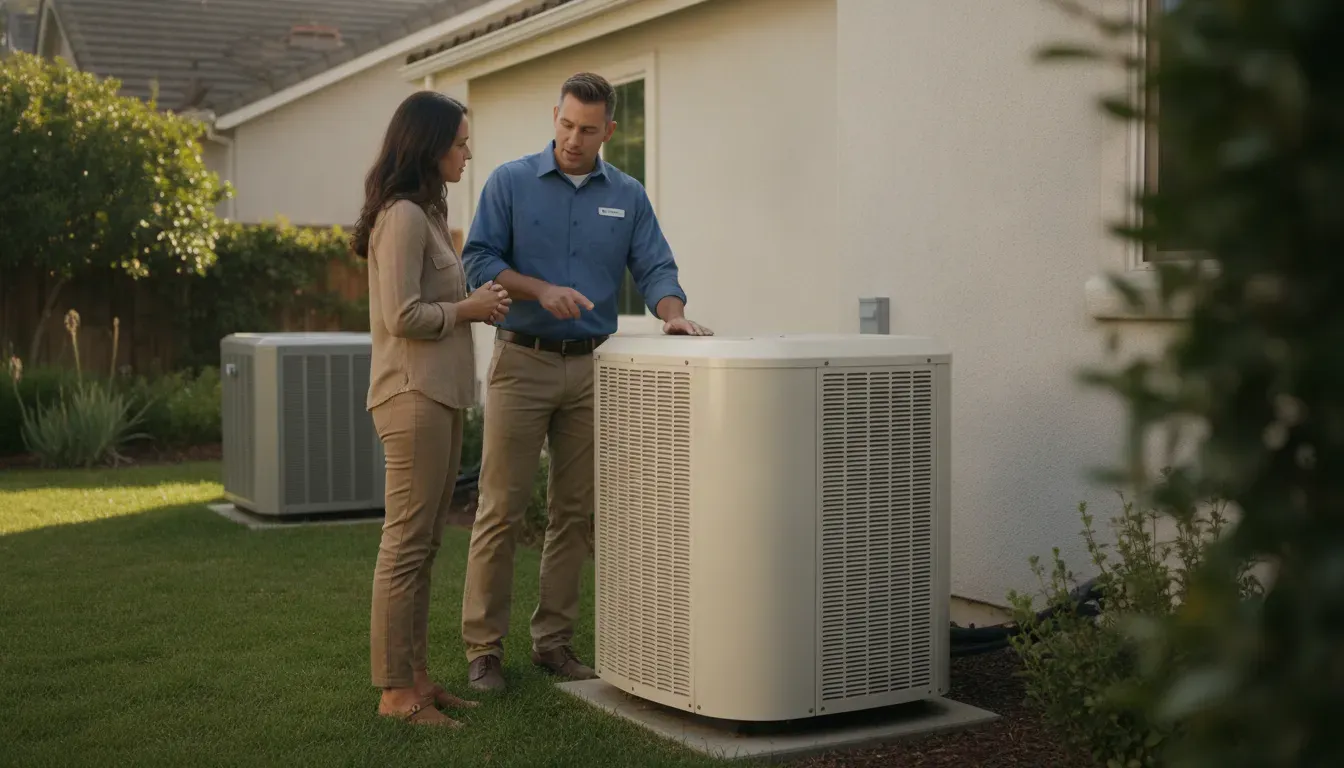
If you are researching variable speed HVAC vs single speed California options, you are probably weighing steadier comfort and possible efficiency gains against a higher equipment and installation investment. The honest answer is conditional: variable-capacity equipment can be valuable in the right home, but a properly sized single-stage system can still be a practical choice. Climate, load, ductwork, controls, utility rates, and installation quality matter more than a label on the outdoor unit.
Call Airteks: (925) 292-0148
For the broader planning context, start with Airteks' Energy Efficiency, Smart HVAC Controls, and Pelican Wireless guide and the residential HVAC guide for Northern California. Then use this comparison to decide what information to request before approving an upgrade in the Bay Area, Sacramento region, or Central Valley.
What Is the Difference Between Single-Stage and Variable-Speed HVAC?
A single-stage, or fixed-capacity, compressor generally has one operating output. It runs at full capacity when there is a call for heating or cooling, then shuts off when the thermostat is satisfied. This straightforward approach can cost less initially and may be easier to match with familiar equipment and controls. Its tradeoff is that the system has less ability to match a mild or changing load.
Variable-capacity equipment can adjust output across a range instead of using only full output or off. During a smaller load, a properly matched system may run longer at a lower capacity. During a larger load, it can increase output. That can reduce temperature swings and frequent starts, but the actual operating range and control method depend on the exact model and matched indoor and outdoor components.
One important clarification: the phrase "variable speed" may describe a compressor, an indoor blower, an outdoor fan, or a communicating system that coordinates several components. A variable-speed indoor blower does not automatically make a compressor variable-capacity. Ask for the equipment documentation and matched-system ratings rather than assuming every variable-speed label describes the same technology.
Single-Stage vs Two-Stage vs Variable-Capacity: A Practical Comparison
| System type | How it operates | Potential strengths | Questions to ask |
|---|---|---|---|
| Single-stage | One primary output, generally full capacity or off | Lower initial complexity, straightforward controls, and often a lower upfront equipment option | Is the system sized correctly, and are the ducts and airflow adequate? |
| Two-stage | Two discrete capacity levels, usually a lower stage and a higher stage | Can offer a middle option for cycling, comfort, and efficiency priorities | What are the actual stage capacities and control requirements for this model? |
| Variable-capacity | Output modulates across a model-specific range to follow demand | May improve part-load comfort, sound, and efficiency when properly matched and installed | What is the modulation range, matched rating, thermostat requirement, and service plan? |
Two-stage equipment deserves a brief mention because it can be a middle ground, but stage percentages are model-specific. Do not use a generic percentage to compare every product. Airteks' planned two-stage versus single-stage article can cover that narrower comparison in greater depth. This article focuses on whether variable-capacity operation is a sensible California upgrade over a single-stage system.
Can Variable-Speed HVAC Improve Efficiency and Comfort?
It can, especially when the system spends meaningful time at part load. Lower-output operation can reduce rapid on and off cycling and may provide steadier supply-air delivery. Longer runtimes can also support moisture removal in some homes. These are potential benefits, not guarantees. Sizing, coil selection, airflow, refrigerant charge, duct leakage, thermostat settings, ventilation, and local indoor moisture loads all influence the result.
Use ratings to compare complete matched systems. SEER2 describes seasonal cooling efficiency, EER2 can help with specified hot-weather performance, and HSPF2 is relevant when a heat pump also provides heating. A higher rating is useful information, but it is not a promise that a household bill will fall by a particular amount. Weather, usage, utility rates, insulation, duct losses, and installation quality remain part of the outcome.
The ENERGY STAR heat pump criteria show why the complete system matters. Certification requirements vary by system type, and split systems must be evaluated as matched indoor and outdoor equipment. For more detail on rating selection, see Airteks' guide to the SEER rating you need in California.
- More even temperatures during mild or changing loads
- Potentially fewer hard starts and less noticeable cycling
- Lower sound during lower-output operation on suitable equipment
- Possible moisture-control benefits when the coil, airflow, and runtime support them
- More control flexibility, often with greater controls and service complexity
DOE research on variable-capacity heat pumps found that performance depends on capacity, cycling, duct conditions, and control strategy. That is why a premium compressor cannot compensate for poor sizing or a leaky duct system. A system assessment should look beyond the outdoor unit's headline rating.
For an equipment and ductwork review, call Airteks: (925) 292-0148
When Is Single-Stage HVAC Still a Reasonable Choice?
Single-stage HVAC is not automatically a bad choice for a California home. It can make sense when the homeowner prioritizes a lower initial investment, familiar controls, straightforward service, or a relatively stable and less demanding load. It may also be appropriate when the existing system, ductwork, and replacement scope do not support a more complex matched system without additional work.
The right question is not whether variable speed is always better. Ask whether the expected comfort and operating benefits justify the additional equipment, controls, installation, and service considerations for this home. If the answer depends on a large efficiency improvement, request the assumptions behind the estimate. A responsible comparison should identify the existing system's condition, the proposed matched equipment, expected runtime, utility rate assumptions, duct and electrical work, and any current incentive.
Also consider serviceability. Variable-capacity systems may use specialized controls and components. That does not make them a poor choice, but it makes documentation, warranty terms, parts support, commissioning, and ongoing maintenance more important. Airteks provides residential AC, furnace, heat pump, replacement, installation, and maintenance services, so an evaluation can compare the whole project rather than push one equipment category. For a deeper look at how energy-efficient HVAC smart controls and Pelican Wireless fit into a broader efficiency plan, review Airteks' related guide.
How Does the California Climate Change the Decision?
California is not one HVAC climate. A coastal or Bay Area home may have long periods of mild weather and a different moisture profile than a Sacramento or Central Valley home exposed to hotter summer conditions. Livermore, Pleasanton, Walnut Creek, Sacramento, and other Northern California communities can require different design assumptions even when two homes have similar square footage.
For a Bay Area or coastal home, ask how the proposed system will handle low loads, shoulder-season cycling, ventilation, humidity, and existing duct limitations. A system that is oversized may satisfy the thermostat quickly without delivering the intended comfort or moisture performance. A properly sized variable-capacity system may be helpful, but only when its controls and airflow are designed for the home.
For Sacramento and Central Valley homes, ask about design cooling conditions, airflow, duct insulation and leakage, electrical capacity, heat-pump heating output, and backup or supplemental heat where applicable. Cooling ratings and installation quality deserve attention in addition to seasonal efficiency. A variable-speed heat pump must be evaluated for both cooling and heating, not just its compressor label.
California Energy Code requirements also vary by project. The California Energy Commission HVAC guidance explains that requirements apply to new construction and applicable additions or alterations, with project and climate-zone considerations. The code should not be treated as a blanket rule that every existing replacement must use variable-speed equipment. Confirm the current code edition, permit date, project scope, and applicable compliance path with the contractor or authority having jurisdiction.
For a broader overview of system choices, see Airteks' guide to the most energy-efficient HVAC systems for a California home. That article covers system categories, while this one focuses on capacity modulation and the single-stage decision.
What Should You Compare Before Paying for the Upgrade?
Compare the complete installed project, not just the outdoor unit. Ask for the following items in writing:
- Load calculation and sizing: What method was used, and how does the selected capacity fit the home's design load?
- Matched equipment: What are the exact indoor and outdoor model numbers, and what are the certified SEER2, EER2, and HSPF2 ratings?
- Modulation details: Is the compressor variable-capacity, or is only the blower variable speed? What is the actual low-stage or modulation data?
- Duct and airflow scope: Will the quote address leakage, insulation, return-air capacity, static pressure, and supply airflow?
- Controls: Does the system require a communicating thermostat or proprietary control? What happens if that control needs service?
- Commissioning: Will the installer verify airflow, refrigerant charge, drainage, thermostat operation, and equipment performance after startup?
- Ownership factors: What are the warranty, maintenance, parts, service, and replacement considerations over the period you expect to own the home?
- Incentives: Which current program rules apply, who submits the paperwork, and must the project receive approval before installation?
For a replacement decision, also review whether repair is still sensible. Airteks' guide to signs your AC needs repair versus replacement can help frame that conversation. A higher equipment tier is not automatically the best investment if the existing ducts, electrical service, or installation plan are not ready for it.
Which California Rebates or Tax Credits May Apply?
Incentives change by utility territory, household income, equipment, project type, installation date, and remaining funds. Check them before signing a contract, and do not assume a program is available because an older article lists it. The TECH Clean California HEEHRA rebate page reported that single-family HEEHRA rebates were fully reserved statewide as of February 24, 2026, and that new income-verification applications were no longer being accepted at that time. That status is a reason to verify current availability, not to count the rebate in a quote.
Utility programs can have separate rules. For example, Sacramento-area homeowners can review the current SMUD heating and cooling rebate requirements, including participating-contractor and equipment conditions. Other Northern California customers should check their own utility's current program administrator. The old federal Energy Efficient Home Improvement Credit also has a time boundary: current IRS guidance states that the credit does not apply to property placed in service after December 31, 2025. Tax questions should go to a qualified tax professional.
Before relying on any incentive, confirm the service territory, open application window, equipment eligibility, income rules, preapproval requirement, installation deadline, documentation, and contractor participation. Airteks' California HVAC rebates and tax credits page is another starting point, but its year-specific information should be checked against the current program administrator.
Before you choose equipment, call Airteks: (925) 292-0148
Frequently Asked Questions
Are variable-speed HVAC systems worth it in California?
Sometimes. Variable-capacity equipment may improve part-load comfort, cycling, sound, and efficiency when it is properly sized, matched, installed, and controlled. A single-stage system is often the lower-upfront-cost option. Compare the home's load, ductwork, climate, utility rates, comfort priorities, serviceability, and replacement horizon before deciding.
Is variable-speed HVAC more energy efficient than single-stage?
It can be more efficient during suitable part-load operation, but the label alone does not predict a household bill. Compare the complete matched system's certified ratings and the installation plan. Weather, usage, thermostat settings, duct losses, airflow, refrigerant charge, maintenance, and utility rates also affect actual energy use.
Does variable-speed HVAC provide better humidity control?
Longer, lower-output runtimes can support moisture removal in some homes, but the result depends on sizing, coil performance, airflow, controls, ventilation, indoor moisture load, and climate. Northern California does not have one uniform humidity profile, so better humidity control should not be promised for every home.
Is single-stage HVAC a bad choice for a California home?
No. Single-stage equipment can be practical when a homeowner values a lower initial investment, simpler controls, or straightforward service. It generally offers less output modulation, so the complete design and installation should be reviewed if temperature variation or cycling is a concern.
Can a variable-speed air handler work with a single-stage compressor?
Sometimes, but only when the manufacturer approves the exact combination and the controls, wiring, airflow, and ratings are compatible. A variable-speed indoor blower does not make a single-stage compressor variable-capacity. Verify the matched system through manufacturer documentation or AHRI-rated data.
Does California Title 24 require variable-speed HVAC?
There is no safe blanket yes or no based only on the speed label. California Energy Code requirements depend on project type, climate zone, equipment, permit or project date, and the applicable compliance path. Ask the contractor or authority having jurisdiction which current requirements apply to the specific project.
Is there a universal HVAC replacement rule based on a dollar amount?
No universal dollar threshold can decide whether to repair or replace a system. Use a current local quote and compare the repair scope, equipment age and condition, expected efficiency, recurring service exposure, installation requirements, incentives, and the time you expect to own the home.
How should homeowners compare HVAC brands and installers?
Do not rely on a brand blacklist. Compare the exact matched-system ratings, warranty terms, controls, parts and service support, sizing method, duct and airflow work, commissioning process, permits, and the installer's ability to explain the recommendation clearly.
Call Airteks: (925) 292-0148 to discuss a variable-speed, single-stage, heat-pump, AC, furnace, or replacement evaluation for your Northern California home.
Comments