
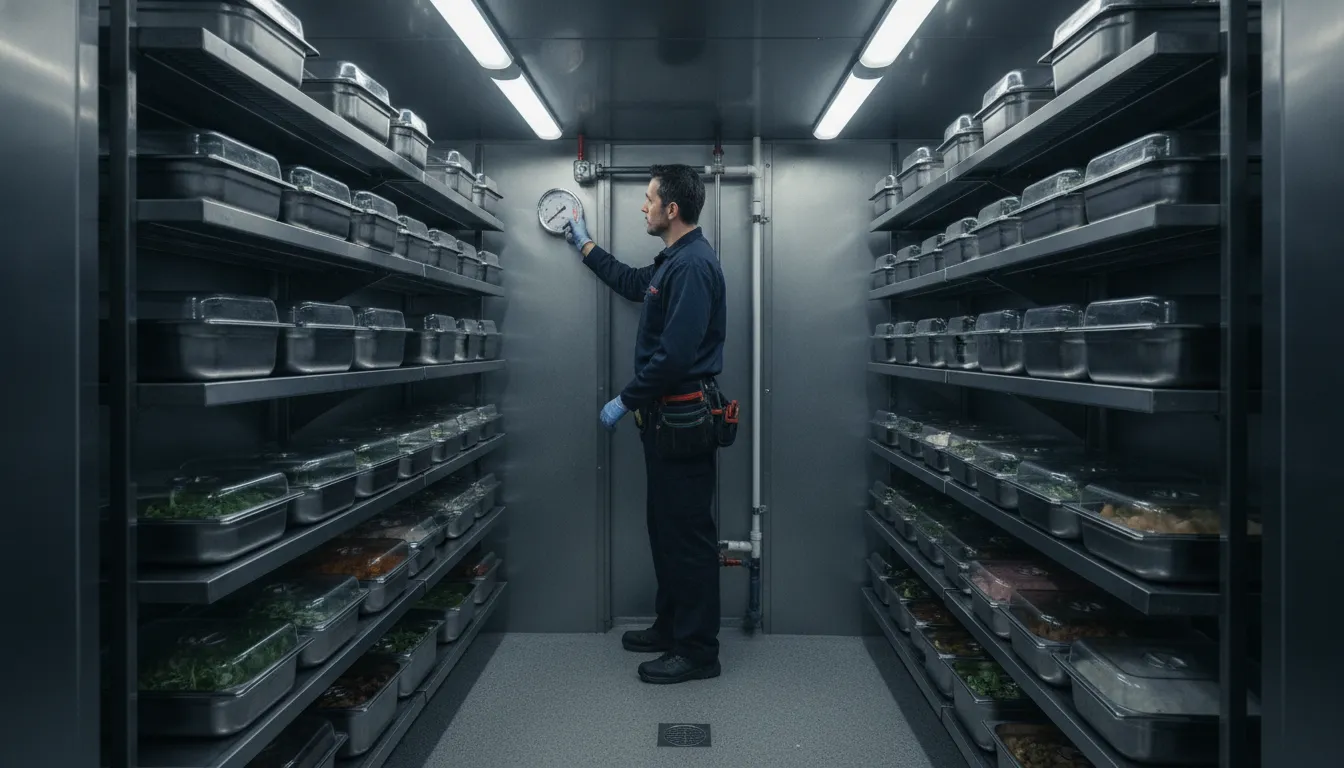
A walk-in that was holding 38 degrees at lunch and reads 47 degrees at dinner is not a problem for tomorrow's service call. For a Bay Area restaurant, market, or cafeteria, the next hour decides how much product you can save and whether you stay open. Emergency commercial refrigeration repair Bay Area operators need is a different job from a scheduled repair. The goal is to protect the food, make a few safe checks, and get a technician the facts while the unit is still cold enough to matter.
Call Airteks at (510) 719-0621 for emergency refrigeration service
This guide covers the first hour only. It tells you how to sort a true emergency from a problem that can wait, what to check without opening a panel, and what to say when you call. It does not diagnose the unit, quote a price, or tell you which food to discard. Those decisions belong to a technician and to your own food-safety procedure.
Is this an emergency or a problem that can wait?
Not every warm box needs an after-hours truck. The split is simple. If the product is already above a safe holding temperature, or the unit is getting warmer while you watch, treat it as an emergency. If the unit is still holding temperature and the issue is a noise, a slow drip, or a worn gasket, it can usually wait for a scheduled visit.
The FDA Food Code requires cold food to be held at 41 degrees Fahrenheit or below. Above that line, food sits in the temperature danger zone, where bacteria grow quickly. The FDA states that rule in the 2022 Food Code, which sets the cold-holding standard food businesses are inspected against. Use it as your line. A unit drifting past 41 degrees with food in it is an emergency. A unit holding steady at 36 degrees with a noisy fan is a repair, not a crisis.
| What you see | How to treat it | Why |
|---|---|---|
| Box temperature climbing past 41 F with food inside | Emergency. Call now and start a temperature log. | Product is entering the danger zone and the clock is running. |
| Unit dark, silent, or the breaker will not stay on | Emergency. Confirm power once, then stop resetting it. | A dead unit warms fast, and repeated resets can point to an electrical fault. |
| Sharp chemical smell, hissing, or anyone dizzy near the unit | Emergency. Get people out, leave the door propped from outside, and call. | Refrigerant in a closed space is a safety problem before it is an equipment problem. |
| Smoke, a burning smell, or a hot electrical panel | Emergency. Kill power if you can do it safely and call. | This is a fire risk, not a cooling complaint. |
| Steady temperature under 41 F, but a new noise, frost, or small drip | Schedule it. Keep watching the thermometer. | The food is still protected, so a planned visit is the better use of the call. |
Two cases override the table. If you smell something sharp and chemical, or anyone near the box feels lightheaded, treat it as a refrigerant leak and keep staff out of the space. If you see smoke or a breaker that trips again the moment you reset it, leave the unit off. Neither of those is something to watch overnight.
What to do in the first hour
Work in order. The first ten minutes are about the food. The next twenty are about safe checks a manager can make without tools. After that, you are gathering what the technician needs. None of these steps involves removing a panel or touching a refrigerant line.
Minutes 0 to 10: confirm and contain
- Read the unit thermometer, then check the food. Write down the time, the air temperature, and the temperature of two or three items: one near the door, one in the middle, one on a top shelf.
- Keep the doors shut. Send one person in with a list instead of letting the crew browse. Every opening dumps cold air.
- Stop adding heat. Hold incoming deliveries, and do not load hot or freshly cooked product into a box that is already struggling.
- Name one owner. That person keeps the log and makes the phone call. Everyone else leaves the unit alone.
Minutes 10 to 30: checks that do not need a technician
These are observations, not repairs. Note each answer so you can repeat it on the phone.
- Power. Are the display, the interior light, and the fans on? A dark unit usually means a loose plug, a tripped breaker, or a disconnect someone switched off while cleaning.
- The breaker, once. If it is tripped, reset it a single time and watch. If it trips again, leave it off and say so when you call.
- The door. Does it close and latch on its own? A door left cracked by a delivery can warm a walk-in as fast as a failed part.
- Airflow. Is product stacked against the evaporator, or is the return blocked by boxes? Restricted airflow is a common reason a box runs warm.
- The condenser area. If you can see the coil without opening a panel, note whether it is packed with dust, flour, or grease. Do not vacuum or wash it during the event.
- Sounds and alarms. Write down any alarm code exactly as it appears, and describe the sound: clicking, short cycling, a buzz, or silence.
Minutes 30 to 60: protect the product
Move the most temperature-sensitive product first, and only into a unit you have already confirmed is cold. Do not shuffle food into a second box that is also running warm. If you have no cold space left, keep the doors closed and let your food-safety plan decide what happens next. Record every temperature and every move. That log is what your inspector, your insurer, and the technician will all ask for later.
What to tell emergency commercial refrigeration repair Bay Area dispatch
A clear call gets the right person and the right parts on the truck. You do not need to know what failed. You need to describe the unit, the behavior, and the access. Have this list in front of you before you dial.
- The unit. Walk-in cooler, walk-in freezer, reach-in, prep table, display case, or a line and bar unit. Give its location in the building and the brand and model if the label is readable without tools.
- The temperatures. The air reading, the food readings, the time you took them, and whether the number is climbing, flat, or falling.
- When it started. During service, after a delivery, after cleaning, or first thing when you opened. Say whether it is constant or comes and goes.
- What you already checked. Power, the one breaker reset, the door, airflow, and any alarm code. Mention anything staff tried before you arrived.
- Safety flags. Any smell, hiss, smoke, water near electrical gear, or a breaker that will not hold.
- Access. Who will meet the technician, where to park, gate or alarm codes, and whether the unit sits in a dining room that is still serving guests.
Airteks covers the equipment a Bay Area kitchen actually runs. That includes walk-in refrigerators and freezers, reach-ins, work-top and prep units, display cases, deli cases, and line and bar refrigeration. The commercial refrigeration service page lists the full set, and technicians take both regular and emergency appointments all 365 days of the year.
Call (510) 719-0621. That number is the one on Airteks' contractor listing and it reaches the office for emergency refrigeration service. Office hours run 6:00 AM to 5:00 PM every day, and emergency service is available by phone outside those hours. The site also lists local lines by region, (925) 292-0148 for the Bay Area, (209) 325-4793 for the Central Valley, and (916) 238-4400 for Sacramento, all on the contact page.
How after-hours coverage actually works
Calling at 9 PM is not the same as calling at 10 AM. It helps to know the difference before you are in it. During the day, the office answers and schedules the visit. After hours, the published emergency line is how you reach a technician, and the person who picks up needs the same facts you would give a dispatcher.
Airteks publishes its hours as 6:00 AM to 5:00 PM, seven days, with emergency service available by phone beyond that window. On the refrigeration side, the company states that technicians are available for emergency appointments 365 days a year. That is the commitment. It is not a promise about how many minutes the drive will take, and no honest contractor can make one across the Bay Area at dinner rush.
What you can control is how ready the site is when someone arrives. Leave one person in charge who can open the door, point out the unit, and hand over the temperature log. Clear a path to the box and to the electrical panel. If the unit is in a guest area, decide in advance whether the technician can work while you are serving. You can also hold the visit until the room clears. Say which one you want when you call.
If the problem is not refrigeration at all but the building's heating or cooling has failed at the same time, the after-hours HVAC repair guide covers that call separately. Keep the two requests distinct so the right technician gets dispatched.
Protecting product while you wait
The technician fixes the equipment. You are responsible for the food. Those are separate decisions, and mixing them up is how product gets kept that should have been questioned, or discarded when it was still safe.
California already tells you how to measure. The Retail Food Code, at Health and Safety Code section 114157, requires a thermometer for each refrigeration unit. It must read the air temperature in the warmest part of the unit and be mounted where staff can see it. The scale has to read in steps no larger than 2 degrees. The full text is on the California Legislative Information site. If your box has no working thermometer, fix that gap now with a calibrated appliance thermometer. Every decision below depends on a number you trust.
While you wait, do four things.
- Keep one written log: unit, time, air temperature, food temperature, and the initials of the person who checked. Start it at the moment you notice the problem, not when the technician arrives.
- Check the food, not just the air. Air temperature swings fast when a door opens. Probe an item in the thickest part, near the center, with a clean thermometer.
- Group product by risk. Ready-to-eat cold food and raw protein need the closest watch. Sealed, shelf-stable backups do not belong in the conversation.
- Follow your own plan. Your county environmental health department sets the rules for what you may keep and what you must discard, and your insurer may want the same log. Do not take that decision from a repair company.
Resist the instinct to spread one failure across the kitchen. Moving warm product into a working cooler can pull that second unit down too. Move only what the receiving unit can absorb, and recheck its thermometer an hour later.
Bay Area conditions that make failures worse
The same cooler fails differently depending on where it sits. A kitchen in Oakland, a prep room in San Jose, and a market in Walnut Creek do not put the same load on a box. Naming the condition helps the technician show up prepared.
- Hot kitchens in a heat wave. When the line is running and the afternoon hits the mid-90s inland, a walk-in's condenser is rejecting heat into air that is already hot. A unit that coasts in May can fall behind in September. Tell the dispatcher if the room around the condenser is unusually hot.
- Delivery-day door time. A Friday receiving rush with the walk-in door open for twenty minutes will spike the box temperature even when the equipment is healthy. If the rise started during receiving and is already falling back, say so. It changes the urgency.
- Coastal humidity and door gaskets. Fog and damp air near the bay load moisture into a box every time the door opens. Heavy frost or water on the floor often traces back to a gasket or to door time, not to a failed compressor.
- Older buildings and shared panels. Plenty of Bay Area restaurants run out of panels that also feed other tenants. If the outage coincided with something else in the building shutting off, mention it. The fault may not be in your unit at all.
Airteks works across the Bay Area from its Livermore base, and the service area map shows the coverage. When you call, name the city and the neighborhood anyway. Drive time and access are part of getting someone to you, and the dispatcher would rather hear "back alley off University, gate code needed" than guess.
One boundary worth knowing: this is commercial equipment. The refrigeration service covers restaurants, grocery, hotels, gas stations, specialty shops, bars, and similar businesses. A household refrigerator is a different call.
After the emergency call
Once the unit is holding temperature again, the emergency is over and a different set of questions starts. Those questions have their own answers, and they do not belong in the middle of a breakdown.
For what a planned repair visit covers and what to record before a technician arrives on a normal day, read the commercial refrigeration repair guide. It also covers how to think about repair versus replacement. It is written for the scheduled visit, not the crisis.
If this was the second or third time the same box has failed, the better spend is a maintenance plan rather than another emergency call. The planned maintenance page describes how Airteks sets those up for commercial sites, and maintenance-agreement customers get priority when something does break.
And if the unit is simply at the end of its life and you are already planning to replace it, the walk-in cooler installation checklist covers the planning side. It walks through sizing, access, and what has to be decided before installation day. Replacing a box is a project. It is not something to arrange while product is warming.
The broader commercial offering, including heating and air conditioning for the same buildings, sits on the commercial services page.
Product warming right now? Call (510) 719-0621 and have your temperature log in hand.
Frequently Asked Questions
Do you offer emergency commercial refrigeration repair in the Bay Area after hours?
Yes. Airteks publishes office hours of 6:00 AM to 5:00 PM every day and states that emergency service is available by phone outside those hours. For refrigeration specifically, technicians take emergency appointments 365 days a year. Call (510) 719-0621 and have the unit type, temperatures, and access details ready.
What temperature means my cooler is in trouble?
The FDA Food Code requires cold food to be held at 41 degrees Fahrenheit or below. If the food itself, not just the air, is climbing past that line, treat it as an emergency and start a written log. A unit that is noisy but still holding well under 41 degrees can usually wait for a scheduled visit.
Can my staff do anything before the technician arrives?
Yes, as long as it stays outside the equipment. Check power, reset a tripped breaker one time only, confirm the door closes, look for blocked airflow, and write down any alarm code. Do not remove panels, touch refrigerant lines, or keep resetting a breaker that trips again.
Should I move the food to another refrigerator?
Only into a unit you have confirmed is cold, and only as much as that unit can take without warming up itself. Keep doors shut otherwise, keep a temperature log, and follow your county environmental health rules and your own food-safety plan for what to keep or discard. A repair technician should not be the one making that call.
How is this different from a regular refrigeration repair visit?
An emergency visit is about stopping product loss tonight. A scheduled repair is about diagnosing the fault, explaining the work, and deciding whether repair or replacement makes sense. That planned visit is covered in our separate commercial refrigeration repair guide, and it is the right next step once the box is cold again.
Comments