
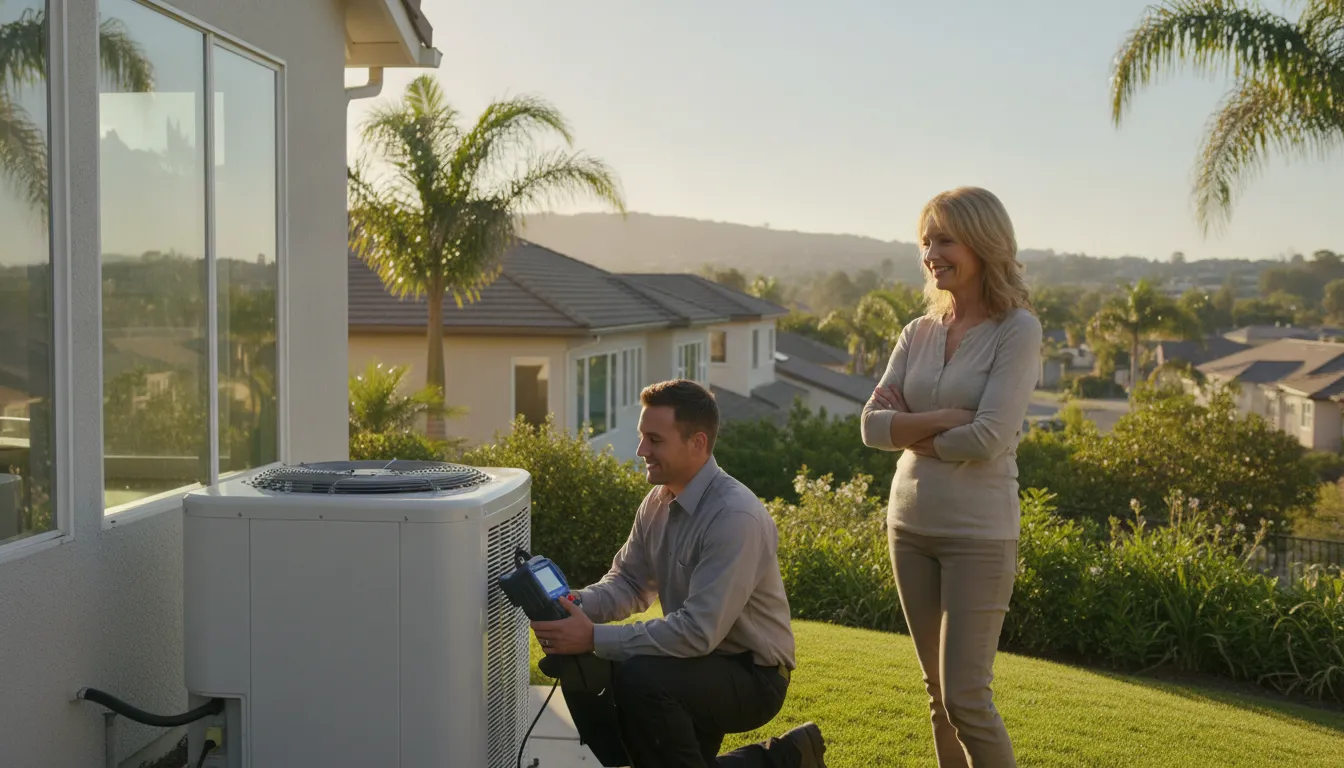
Choosing an HVAC contractor is about more than finding the fastest appointment or the lowest estimate. Before any work begins, confirm that the company holds the right California credentials and carries proper insurance. Ask who will be responsible for the job. That one pre-hire check can protect your home, your budget, and your peace of mind.
Call (510) 719-0621 to schedule dependable HVAC service or request a quote from a licensed team.
Yes, California requires a CSLB license for HVAC work that needs a building permit, uses employee labor, or totals $1,000 or more in combined labor and materials.
Most heating and cooling contractors hold a C-20 classification. Verify any contractor by license number, business name, or personnel name using the CSLB Check A License tool before you sign.
Licensing is more than a formal requirement. It helps you identify an accountable, insured professional and spot real risks. Unlicensed work can lead to faulty repairs, property damage, and liability if someone is hurt on your job. For a broader look at planning and maintaining your system, see this complete residential HVAC guide for Northern California. First, it helps to understand which license classification applies to HVAC work and exactly when California requires one.
What License Does an HVAC Contractor Need in California?
California regulates HVAC contracting through the Contractors State License Board (CSLB). For most heating, ventilation, and air-conditioning contracting, the required classification is C-20, officially called Warm-air heating, ventilating, and air-conditioning. Refrigeration work falls under the separate C-38 classification. These classifications help define the trade a contractor is qualified to perform, rather than serving as a general substitute for checking the contractor's current license status.
The licensing requirement applies broadly. A contractor must hold a current, valid CSLB license when the project requires a building permit, uses employee labor, or combines labor and materials at $1,000 or more. That threshold is based on the total project value, not just the equipment or the installation labor. The CSLB licenses contractors across 45 trade classifications, so the classification shown on a license matters.
Requirements behind a C-20 HVAC license
A C-20 applicant must demonstrate four years of journey-level experience performing HVAC work before applying. Applicants for C-20 and C-38 classifications must also provide EPA Section 608 Type II or Universal certification. The CSLB began strictly requiring proof of that certification for these applicants on January 1, 2025. Section 608 certification addresses the safe handling of regulated refrigerants, while the CSLB classification addresses the contractor's trade scope.
- C-20: Warm-air heating, ventilating, and air-conditioning.
- C-38: Refrigeration.
- Experience: Four years of journey-level HVAC experience for a C-20 applicant.
- Refrigerant credential: EPA Section 608 Type II or Universal certification for C-20 and C-38 applicants.
- Project trigger: A valid CSLB license is required for permit-required work, employee labor, or projects valued at $1,000 or more in combined labor and materials.
A license is one part of a responsible hiring decision. Homeowners should also confirm the license is active, the business name matches the contractor they are hiring, and the contractor carries appropriate insurance and bond coverage. For broader guidance on heating and cooling decisions in the region, see this complete residential HVAC guide for Northern California.
Do HVAC technicians need to be licensed in California?
Not every individual technician holds a separate contractor license. The contracting business responsible for the project must hold the appropriate CSLB classification when California law requires a license. Ask which licensed contractor is responsible for the work, then verify that business and classification through the CSLB before signing an agreement. A contractor license number is numeric, can contain up to eight digits, and does not include letters. This distinction helps prevent confusion between an employee's role and the licensed contractor overseeing the contract.
Is Your HVAC Contractor Licensed in California? How to Check
If you are asking, "is hvac contractor licensed california," do not rely on a business card, online review, or verbal assurance. Verify the contractor directly through the California Contractors State License Board (CSLB) before work begins or you sign an agreement.
- Ask for the license number. A California contractor license number contains only numbers, with up to eight digits. It should not include letters. Ask the contractor to provide the number for the business that will sign your contract, not just an individual technician's name.
- Open the CSLB Check A License tool. Use the CSLB's Check A License lookup and search by license number, business name, or personnel name. Searching by number is usually the most direct option, while a business-name search can help you compare the result with the name on your estimate.
- Confirm the status is current. Check that the record is active and current rather than expired, suspended, or otherwise inactive. Review the classification as well. A contractor performing heating, ventilation, and air-conditioning work generally holds the CSLB C-20 classification, while refrigeration work is classified separately as C-38.
- Compare the record with your paperwork. The business name, personnel, and license information should match the written proposal and the company representative you are dealing with. For additional help, call the CSLB at (800) 321-CSLB (2752).
What the CSLB check can and cannot tell you
A license search shows information from the CSLB license database and can include complaint disclosure. However, that disclosure is not a complete record of every disagreement or legal issue. California Business and Professions Code 7124.6 limits what complaint information may be disclosed. Section 7071.17 limits disclosure to certain construction-related civil judgments reported to the CSLB.
Use the result as one part of your hiring review. A trustworthy HVAC contractor should also be willing to provide proof of insurance, explain the proposed work, and give you a clear written quote. Knowing what an HVAC quote should include makes it easier to compare the contractor's scope with the license and classification you verified.
- Save or print the CSLB license record before signing.
- Check the license again if the project is delayed or the business name changes.
- Do not assume a license is valid merely because a number appears on an estimate.
- Ask who will pull required permits and which licensed business is responsible for the contract.
How do I check if my HVAC contractor is licensed?
Use the CSLB Check A License tool and search by the contractor's license number, business name, or personnel name. Confirm the record is active and current, review its classification, and compare the result with your contract. If you cannot verify the information online, call (800) 321-CSLB (2752) before authorizing the work.
Why Unlicensed HVAC Work Is a Serious Risk
Hiring an unlicensed HVAC operator can create financial and safety problems that are easy to overlook when a quote appears cheaper. California law generally requires a current CSLB license for work that requires a building permit, uses employee labor, or totals $1,000 or more in labor and materials. The California Contractors State License Board explains the risks of unlicensed work in direct terms.
- Injury liability: If a worker is injured on your property, you could face financial liability when the operator does not carry workers' compensation insurance. CSLB warns that few, if any, unlicensed individuals have this coverage or the required bond.
- Property damage: HVAC work involves electrical connections, refrigerant, gas, combustion, ductwork, and equipment that can affect the rest of your home. An installation mistake can damage the system or surrounding property, leaving you to pursue an operator who may lack insurance or a reliable business structure.
- Incomplete or faulty work: A quick repair that misses the underlying problem can lead to repeat service calls, premature equipment failure, poor comfort, or safety concerns. CSLB states that the quality of work from unlicensed operators usually does not compare with licensed contractors.
- Permit and insurance complications: If required permits were skipped or the work fails inspection, correcting the project may become your responsibility. Unpermitted or defective work can also complicate a future home sale and may create questions when you submit a property-damage or equipment-related insurance claim. Confirm permit requirements and coverage before work begins.
- Higher total cost: Saving on the initial quote may not save money after callbacks, replacement materials, repairs to damaged property, or a second contractor's corrective work. CSLB cautions that homeowners will probably end up paying more in the long run.
| Factor | Licensed HVAC contractor | Unlicensed operator |
|---|---|---|
| State license | Current, verifiable CSLB C-20 license | No verifiable license number |
| Workers' compensation | Typically carries required coverage | Rarely carries any coverage |
| Bond / insurance | Required bond and liability coverage | Few, if any, hold a bond |
| Recourse | Complaint disclosure via CSLB and accountability | Hard to pursue if work fails |
| Quality risk | Professional, inspected work | Faulty or incomplete work likely |
What happens if your HVAC contractor isn't licensed?
You may be left responsible for an injured worker, unfinished work, equipment damage, or the cost of bringing an unsafe installation up to code. You may also have limited leverage if the operator disappears or disputes responsibility. Before signing, ask for the contractor's license number and verify that it is active with CSLB. Confirm that the license classification matches the HVAC work and request current proof of workers' compensation and liability insurance.
A valid license is not a guarantee that every project will be perfect, but it is an important baseline for accountability. For more planning guidance, review this complete residential HVAC guide for Northern California and choose a contractor who explains the work, permits, equipment, and warranty responsibilities clearly.
Questions to Ask Before Hiring an HVAC Contractor
A few direct questions can help you separate a qualified HVAC professional from someone who is not prepared to protect your home, your budget, or your family. Ask for clear answers before work begins, and verify important details independently rather than relying only on a sales conversation.
- May I see your CSLB license number and current license ID? A California contractor license number contains up to eight digits and no letters. Ask to see the physical license, then compare the business name and status with the Contractors State License Board record.
- Is the license active, and does it cover C-20 HVAC work? The CSLB C-20 classification covers warm-air heating, ventilating, and air-conditioning. If the project includes refrigeration, ask whether the contractor also holds the appropriate classification. You can verify a contractor by license number, business name, or personnel name through the CSLB Check A License tool.
- Are you insured, and do you carry workers' compensation insurance? Ask what coverage applies to the job and request documentation when appropriate. Workers' compensation coverage matters because a homeowner may face serious exposure if a worker is injured while working on the property.
- Will you provide a written, itemized quote? The proposal should make the scope understandable, including the equipment or parts, labor, permits, project assumptions, and warranty details that apply. For a practical breakdown, review what an HVAC quote should include before comparing proposals.
- Can you provide references or point me to recent reviews? Look for feedback about communication, workmanship, cleanup, follow-through, and how the contractor handled problems after installation or repair. A long list of reviews is less useful than consistent detail from real customers.
- Will you pull the required permits? Ask who handles permits, which permits the project requires, and whether inspections are included in the plan. Do not assume that a low quote includes permit work unless the proposal says so clearly.
- Who will perform the work, and who is responsible for the project? Confirm whether the contractor uses employees or subcontractors, who supervises the job, and whom you should contact if the scope changes or an issue appears.
Who needs a contractor license in California?
In California, a contractor generally needs a current CSLB license when the work requires a building permit. Uses employee labor, or combines labor and materials at $1,000 or more. HVAC contractors typically work under the C-20 classification. These requirements are summarized in the CSLB's consumer guidance at cslb.ca.gov. If a job seems to fall under the requirement, ask the contractor to explain the classification and verify the answer with the CSLB before signing.
Trustworthy contractors should not object to reasonable verification. If someone refuses to provide a license number, avoids questions about insurance, or pressures you to skip permits, treat that as a warning sign and keep looking.
Why Airteks Is a Trusted Licensed HVAC Contractor in Northern California
Choosing an HVAC company is about more than finding someone who can replace a filter or restore cold air. You want a contractor with the credentials, experience, and accountability to work safely in your home, business, or school facility. Airteks is licensed and insured for commercial and residential HVAC work, and has served Northern California since 1997.
That long history includes work for homeowners, commercial property owners, facility managers, and K-12 school districts across the Bay Area, Central Valley, and Sacramento. Whether the job involves installation, repair, replacement, or ongoing maintenance, the goal is a dependable heating and cooling solution. Recommendations are suited to the building and its occupants, not rushed toward a sales target.
Experience backed by qualified technicians
Airteks employs factory-certified technicians with more than 25 years of HVAC industry experience. Factory certification reflects training on specific equipment and systems, while hands-on field experience helps technicians diagnose the underlying problem instead of treating only the most visible symptom. That combination matters when a repair affects comfort, energy use, indoor air quality, or the operating schedule of a commercial facility.
Airteks also supports customers with a full range of residential and commercial services. Businesses and facility teams can hire a licensed HVAC contractor familiar with the demands of larger buildings and ongoing service. Homeowners can review the company's approach through this licensed HVAC contractor in California resource.
Clear recommendations without pressure
Trust is built through the service experience as much as through a license or certification. Airteks provides upfront, transparent pricing without listing a one-size-fits-all price or pushing unnecessary work. Technicians explain what they find, outline practical options, and make recommendations based on the system's condition, the building's needs, and the customer's priorities. The approach is designed to avoid pressure and upselling, including when a repair may be the sensible choice instead of replacement.
For urgent heating or cooling problems, Airteks offers 24/7 emergency availability. That matters when a failed system affects a household, disrupts business operations, or creates difficult conditions in a school facility. To schedule service or request a straightforward recommendation, call (510) 719-0621.
Call Airteks at (510) 719-0621
Frequently Asked Questions
Do HVAC technicians need to be licensed in California?
The business or contractor responsible for the HVAC contract generally needs a current CSLB license when the work requires a permit. Uses employee labor, or totals $1,000 or more in combined labor and materials. Individual technicians may work under the licensed contractor's responsibility, so ask which licensed business is signing your contract.
What license does an HVAC contractor need in California?
Most heating, ventilation, and air-conditioning contractors need the CSLB C-20 classification, officially called Warm-air Heating, Ventilating, and Air-Conditioning. Refrigeration work falls under the separate C-38 classification. Ask for the classification that matches the work, rather than accepting a license number without checking its details.
How can I verify an HVAC contractor's license?
Use the CSLB Check A License tool and search by the contractor's license number, business name, or personnel name. A California contractor license number contains up to eight digits and no letters. Confirm that the status is current and that the classification matches your project. You can also call CSLB at (800) 321-2752. The database may show complaint information, but disclosures are limited by California law.
What happens if an HVAC contractor is not licensed?
Unlicensed work can leave you exposed if a worker is injured, your property is damaged, or the project is incomplete or faulty. CSLB warns that few unlicensed individuals carry a bond or workers' compensation insurance, which can increase a homeowner's financial responsibility. Verify the license before work begins, and ask for proof of insurance and a written contract.
Schedule HVAC Service With a Licensed Team
When you want dependable guidance for a heating or cooling project, Airteks can help you plan the next step with clear, honest recommendations. Schedule HVAC service or request a free consultation by calling (510) 719-0621. Whether you need residential or commercial support, a conversation with the right contractor can make the process easier to navigate.
Comments