
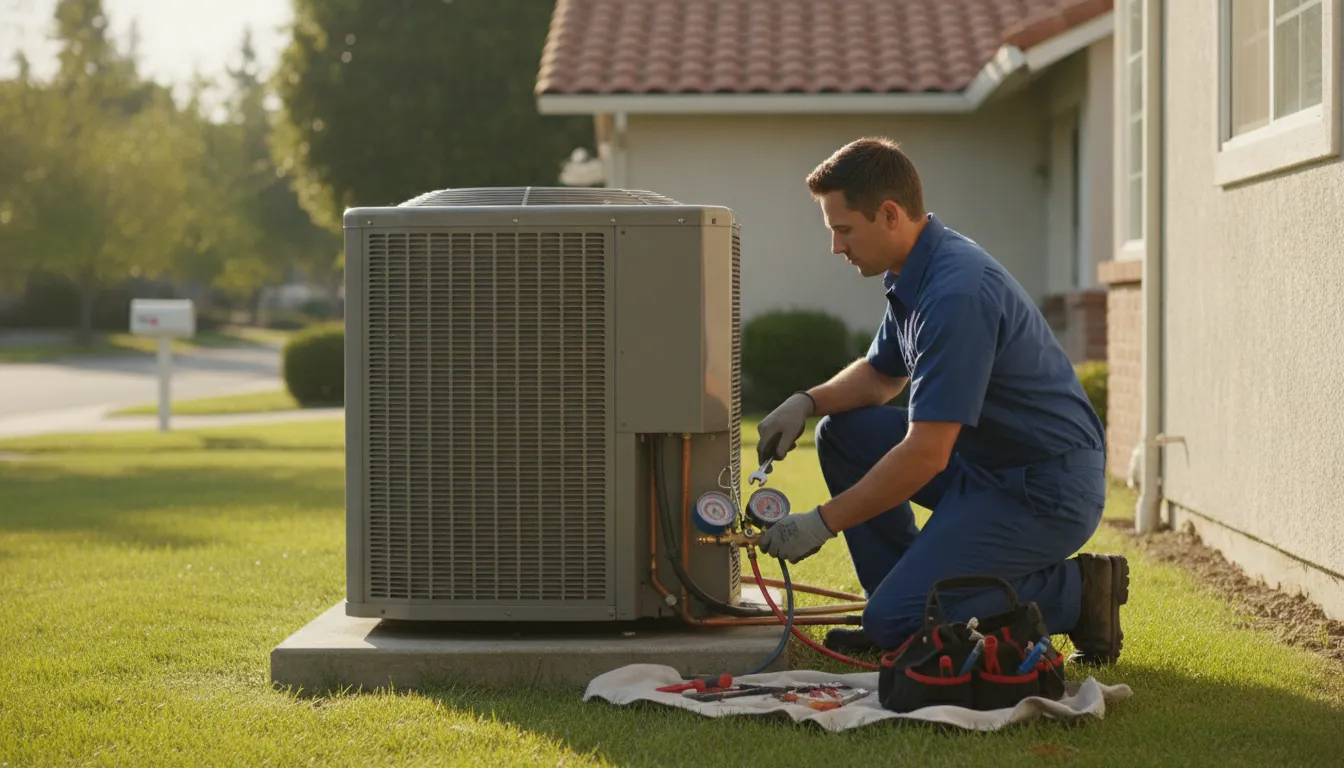
When your air conditioner runs but the vents push out warm or barely cool air, the problem can worsen quickly during a Northern California heat wave. A restricted filter or frozen evaporator coil may limit airflow, while a refrigerant leak can leave the system running without effectively removing heat and humidity. Visible ice on the copper lines, weak airflow, or water around the indoor unit are useful clues, but they do not identify the failed component by themselves.
The ac not blowing cold air repair cost depends on the cause, from a relatively simple airflow correction to a larger refrigerant, electrical, or compressor repair. A technician should test the system before recommending a part, then provide a custom quote rather than relying on a standard price list.
This guide explains what you can safely observe, which tests separate common causes, and how typical estimates fit into the bigger picture. For broader planning, see Airteks' HVAC repair and replacement cost guide. Start by narrowing down why the system is running without cooling.
Why Is Your AC Running But Not Cooling?
When the system runs but the vents deliver warm or barely cool air, the problem usually involves airflow, refrigerant, or an electrical component. Several faults can look alike, so replacing a part before testing the system can waste money and leave the real problem unresolved.
A frozen evaporator coil
Restricted airflow is one of the most common paths to a frozen indoor evaporator coil. If not enough warm indoor air moves across the coil, moisture can freeze on its surface and block heat transfer. Look for weak airflow at the vents, ice or frost on the copper refrigerant lines. Or condensation and water near the indoor unit as the ice begins to melt. These are recognized signs of a frozen coil, not proof that the system needs replacement. Source: Florida PACE.
Dirty filters and blocked airflow
A clogged filter can restrict the air moving through the system and contribute to coil icing. Blocked coils, obstructed returns, and duct problems can create similar symptoms. Start with the filter if it is visibly dirty, but avoid assuming that a new filter solves everything. A blower motor that is dragging can also reduce airflow and may fail prematurely when the restriction continues.
Low refrigerant from a leak
Refrigerant does not normally disappear during ordinary operation. A pinhole or other leak in the refrigerant lines can reduce the system's ability to remove heat and humidity, causing warmer air at the registers. Finding and repairing the leak matters. Adding refrigerant without addressing the source may provide only temporary relief. A technician may inspect both the indoor coil and outdoor condenser, then use an appropriate leak-detection method.
A failing capacitor or blower
The outdoor unit may run while a weak capacitor prevents a motor from starting or running correctly. In other cases, the blower may be struggling, producing low airflow even though the thermostat is calling for cooling. Electrical readings and airflow measurements help separate these faults from a frozen coil or refrigerant problem.
Quick symptom checklist: warm air with weak airflow points toward a filter, blower, or frozen coil. Visible ice suggests coil freezing, while normal airflow with steadily warmer air can indicate low refrigerant. Clicking, humming, or an outdoor fan that struggles to start may indicate a capacitor issue. For more troubleshooting context, review these common AC problems.
Airteks takes a test-first approach and gives an honest recommendation based on the equipment's condition. A proper diagnosis is the best way to know whether a focused repair is appropriate, rather than guessing from a symptom alone.
Low Refrigerant vs Dirty Filter vs Failed Compressor: Diagnosis and Cost
Several different failures can produce the same complaint: the system runs, but the air feels warm. A dirty filter restricts airflow and may contribute to a frozen evaporator coil. Low refrigerant from a pinhole leak can also leave the system blowing warmer air. While a failing capacitor, blower motor, or compressor can prevent the equipment from moving or cooling air correctly. The table below gives typical estimates for common repairs, not a standard price list.
| Cause | Symptom | Typical repair cost range | DIY or pro |
|---|---|---|---|
| Dirty filter. | Weak airflow, uneven cooling, or a coil that begins to freeze. | About $20-$75 for a filter and basic service; more if restricted airflow caused additional damage. | DIY filter replacement is reasonable. Use a pro if airflow remains weak or ice returns. |
| Low refrigerant from a leak. | Warm supply air, long run times, or ice on the refrigerant lines. | About $200-$600 for a recharge estimate; leak repair can add to the total. | Pro only. Refrigerant handling and leak repair require specialized equipment. |
| Failing capacitor. | Outdoor unit hums, struggles to start, or shuts down unexpectedly. | About $150-$300. | Pro only. The component stores dangerous electrical energy. |
| Failing blower motor. | Little or no air from vents, unusual noise, or inconsistent airflow. | About $300-$700. | Pro. Diagnosis must separate the motor from a control, wiring, or airflow problem. |
| Failed compressor. | System runs without cooling, trips a breaker, or makes loud mechanical noises. | About $800-$2,000 or more; some estimates reach $900-$2,900. | Pro only. Compressor replacement requires refrigerant and electrical work. |
These ranges are typical estimates compiled from published repair-cost references, including Kahn Air and Trane, and actual pricing varies by equipment, parts, access, refrigerant, and labor. Airteks provides a custom quote after diagnosis, never a standard price list. For additional context, see this HVAC repair and replacement cost guide and learn more about what AC repairs typically cost.
How a technician confirms a refrigerant leak
Adding refrigerant without finding the leak is usually temporary. A technician may inspect both the indoor and outdoor units, then use soapy water to look for bubbles. Ultraviolet dye and a blacklight to find fluorescent marks, or an electronic detector that senses refrigerant-related ions. Those checks help identify whether the problem is a leaking line, coil, or connection before repair and recharge.
Why testing comes before replacing parts
A reliable service visit should include static-pressure testing, supply-and-return temperature readings, and electrical measurements. This test-first approach helps distinguish a restricted filter from a failing blower, capacitor. Or compressor, so you do not pay to replace a part that was never the cause.
What Does It Cost to Repair an AC That's Not Blowing Cold Air?
Warm air from the vents is an urgent symptom, especially during a Northern California heat wave. The repair may be relatively simple, such as a failed capacitor, or it may involve a major component. Typical estimates can help you understand the possibilities, but they are not a substitute for testing the system.
Typical repair ranges
Common AC repairs may fall within these broad ranges:
- Capacitor: $150 to $300.
- Refrigerant recharge: $200 to $600.
- Fan motor: $300 to $700.
- Thermostat: $150 to $500.
- Compressor: $800 to $2,000 or more, with some system and equipment combinations reaching $2,900.
- Evaporator coil: $1,000 to $5,000 or more.
These figures are typical industry estimates reported by Kahn Air and Trane. Airteks does not publish a fixed price list. The exact cost depends on the equipment, the failed part, accessibility, refrigerant requirements, and whether the underlying problem caused additional damage. A technician should provide a custom quote after diagnosis. For more context, see our guide to how much AC repairs cost.
Why a refrigerant recharge may not solve the problem
A refrigerant recharge can restore cooling temporarily, but it will not permanently solve a leak. Pinhole leaks in refrigerant lines can allow the system to lose its cooling capacity, which is why an AC with a leak may blow warmer air. A proper service call checks both the indoor evaporator area and the outdoor condenser unit to locate the leak source. Depending on the system, technicians may use soapy water, an electronic detector, or ultraviolet dye and a blacklight.
Because several failures can produce the same warm-air symptom, a test-first diagnosis is the safest way to avoid paying for the wrong repair. Static pressure, temperature split, and electrical readings can help identify whether the issue is airflow, refrigerant, or a component failure.
When This Symptom Means You Need a New System
Not every no-cool call means your air conditioner needs to be replaced. A restricted filter, failed electrical component, or airflow problem may be repairable. The decision changes when diagnosis finds a failing compressor or another major refrigerant repair on an older system. Those repairs can climb past $800, and putting that money into aging equipment may not provide good long-term value. The right answer depends on the unit's age, condition, repair history, efficiency, and the cost of a properly matched replacement.
Use the repair cost in context
Homeowners sometimes refer to the "$5,000 rule" for AC decisions. It is not a law or a universal estimate. The practical idea is to compare a major repair with the cost of replacement: when the repair approaches roughly half the price of a new system. Replacement often deserves serious consideration. A compressor replacement can be especially difficult to justify on an older unit, but a technician should test the system and explain the options before recommending either path. Airteks provides a custom quote after diagnosis rather than relying on a standard price list.
For additional context, review these signs you should repair or replace and see what it costs to install a new AC. A published range cannot account for your home's ductwork, electrical requirements, equipment condition, or installation details.
Make sure the next system solves the original problem
Replacement is not automatically an upgrade if the underlying installation is wrong. Oversized equipment can short-cycle, while weak airflow, leaky ducts, poor charging, and poor installation can reduce comfort and shorten equipment life. In older Central Valley homes, ductwork may run through hot attic spaces, making leakage and insulation especially important. The U.S. Department of Energy places California in the hot-dry region for central AC efficiency comparisons, so sizing, airflow, and system matching deserve careful attention.
Before accepting a replacement bid, ask for the AHRI matched system number and verify it in the AHRI certification directory. That check confirms the indoor and outdoor components are recognized as a matched combination. A dependable replacement proposal should also explain how the contractor will address ducts, airflow, sizing, and installation quality, not just name a new condenser.
How Fast Can Airteks Diagnose and Fix a No-Cool AC?
When your air conditioner is running but the air coming from the vents is warm, fast service matters, especially during a Bay Area heat wave. Airteks offers same-day service when scheduling allows, along with 24/7 emergency availability for urgent cooling problems. The goal is not to rush into replacing a part. It is to identify the cause and explain the right repair clearly.
A test-first visit prevents guesswork
During a diagnostic visit, an Airteks technician checks the system as a whole rather than assuming the first suspected component is the problem. Static pressure readings help identify airflow restrictions. A temperature-split test shows how effectively the system is transferring heat. Electrical readings help determine whether a capacitor, motor, or another component is actually failing. This test-first approach supports the right fix the first time instead of unnecessary parts replacement.
That matters because warm air can result from very different issues. Restricted airflow may contribute to a frozen evaporator coil, while a refrigerant line leak can leave the system unable to remove heat effectively. The technician may need to inspect both the indoor and outdoor units before recommending a repair. Airteks provides an honest recommendation based on the equipment's condition, not an automatic upsell.
Local service for homes, businesses, and schools
Airteks has served Northern California from its Livermore base since 1997. Its licensed and insured team works on all makes and models for residential customers, commercial facilities, and K-12 schools. Service is available in Livermore, Pleasanton, Walnut Creek, Dublin, Sacramento, Stockton, Modesto, the broader Bay Area, and the Central Valley.
For context on what can affect a repair decision, review the Bay Area HVAC repair and replacement costs. If your AC has stopped cooling, call (510) 719-0621 to request service and get a custom recommendation after diagnosis.
Frequently Asked Questions
What is the $5,000 rule for AC replacement?
The $5,000 rule is a budgeting shortcut: multiply the system's age by the estimated repair cost. If the result is above $5,000, compare the repair with replacement. It is not a diagnostic standard, and it should not replace an inspection of the equipment's condition, efficiency, ductwork, and expected remaining life.
Why is my AC running but still blowing warm air?
Common causes include a dirty filter, restricted airflow, a frozen evaporator coil, low refrigerant from a leak, a blocked coil, or a blower motor that is dragging. Weak airflow, ice on the copper lines, and water around the indoor unit can point to a frozen coil. Turn the system off and arrange service rather than continuing to run it. Source: Florida PACE.
What is the most expensive repair on an AC unit?
A compressor repair or replacement is usually among the most expensive repairs. A California cost guide lists compressor work at approximately $800 to $2,000 or more, but the actual price depends on the system, parts, access, refrigerant requirements, and labor. Airteks provides a custom quote after diagnosis, not a standardized price list. Source: Kahn Air Conditioning.
Will homeowners insurance pay for AC repair?
Usually, homeowners insurance does not cover ordinary wear and tear, maintenance, or an aging air conditioner. Coverage may differ if the damage resulted from a covered event, such as a fire or certain storm damage. Review your policy and ask your insurer about the specific cause before assuming a repair will be reimbursed.
Ready to Get Your AC Cooling Again?
A no-cool AC diagnosis can identify whether the problem involves airflow, refrigerant, or a failing component, so you can make an informed repair decision. For a fast, honest diagnosis, call Airteks at (510) 719-0621. Their team can assess your system and explain the next practical step without pushing a one-size-fits-all solution.
Comments