
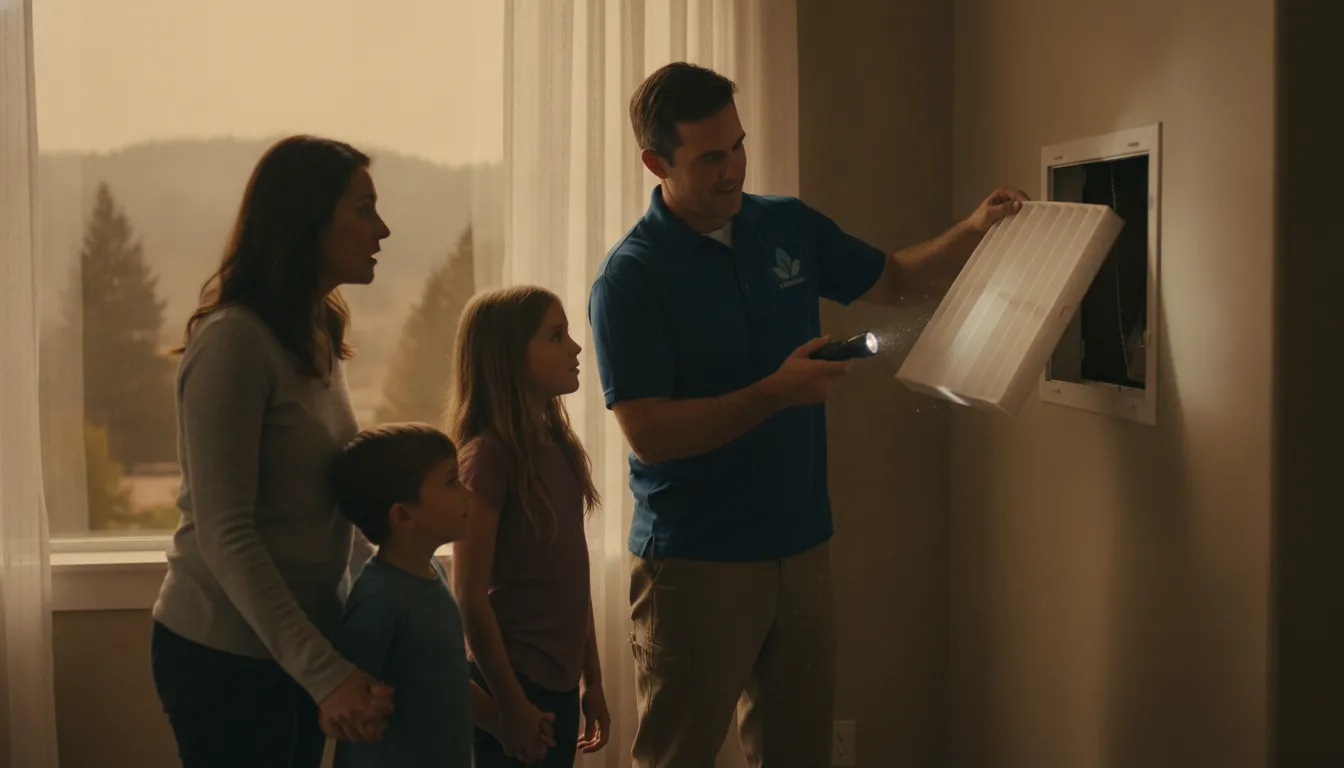
In Northern California, smoke readiness is not just about swapping in a thicker filter. Start by learning how your system handles outdoor air. Check which filter it can safely support before conditions turn smoky.
Contact Airteks about wildfire smoke preparation
To prepare HVAC for wildfire smoke California homeowners may encounter, make a system-specific plan before smoke arrives. Confirm a compatible filter, learn whether the system has a fresh-air intake, and know which controls it can safely use, as the EPA recommends.
Smoke can enter homes and affect indoor air even when a fire is far away. HVAC filtration can help, but it is not the only factor; understanding your equipment's settings is part of energy-efficient HVAC and smart controls. Start by looking at how smoke can find its way inside.
How to Prepare HVAC for Wildfire Smoke in California Homes
Smoke can affect indoor air even when a wildfire is far away. The U.S. Environmental Protection Agency (EPA) explains that wildfire smoke contains gases and fine particles. Some outdoor smoke can enter a home and affect indoor air quality. During an event, particles may come inside through open doors or windows and small gaps around the building. HVAC equipment can be another route when a system draws in outdoor air through a fresh-air intake, or when duct connections and return-air pathways are not well sealed.
These routes matter because closing windows does not automatically make indoor air smoke-free. If your system has a fresh-air intake, it may bring outdoor air into the home as part of its design. The EPA advises homeowners to ask an HVAC professional how to close that intake if the system has one. Do not assume every system has the same controls, or change dampers without understanding how your equipment is configured.
There is also a difference between limiting smoke entry and filtering air that is already circulating. A compatible HVAC filter can capture some particles as air passes through it. Filtration does not seal building gaps or guarantee smoke cannot enter. Closing openings can reduce one pathway, but it will not remove particles already inside. Effective preparation considers both smoke entry and a filter the system can safely use.
In California, smoke can travel well beyond the immediate fire area, so checking local air-quality alerts is useful even when flames are not nearby. Follow evacuation orders and public-safety guidance first. For a wider overview of home filtration and ventilation choices, see Airteks' California home HVAC air-quality strategies. If you are reviewing how system controls affect airflow and operation, Airteks also explains energy-efficient HVAC and smart controls.
EPA wildfire smoke and indoor-air guidance explains why smoke can affect indoor air and why preparation goes beyond the HVAC filter.
Best HVAC Filter Ratings for Wildfire Smoke in California Homes
MERV, or Minimum Efficiency Reporting Value, is a rating used to compare how effectively an air filter captures particles. For wildfire smoke, a higher-efficiency filter can trap more smoke particles, but the highest rating is not automatically the right choice for every furnace or air conditioner.
| Decision point | Practical guidance |
|---|---|
| Filter efficiency | EPA recommends MERV 13 or higher when the HVAC system can accommodate it. |
| System compatibility | Check the equipment manual, filter size, and fit; ask an HVAC professional if capacity is unclear. |
| Filter choice | Use a compatible mechanical filter and keep suitable replacements on hand. |
What rating should you consider?
The U.S. Environmental Protection Agency (EPA) recommends choosing MERV 13 or higher for smoke filtration when the HVAC system can accommodate it. EPA also explains that higher-efficiency mechanical filters can trap smoke particles without producing ozone. That makes a compatible mechanical filter a useful part of a smoke-preparation plan, not a guarantee that smoke will be kept out of the home.
Compatibility matters because a filter that is too restrictive for a particular system can interfere with airflow. Before moving to a higher MERV rating, check the equipment manual and the filter size and fit. If the manual does not clearly identify an appropriate option, ask an HVAC professional to confirm what the system can handle. EPA specifically advises consulting a professional about high-efficiency filters. Read its indoor air filtration guidance and wildfire preparation recommendations for more detail.
Why system limits should guide the choice
California's Cal/OSHA wildfire-smoke information page reports guidance from California Air Resources Board staff. They advised that most HVAC systems should accommodate pleated medium-efficiency MERV 6 to 11 filters, while some may use MERV 13 or higher. The observation appears in workplace guidance, not as a universal residential rule. Check each home's equipment and installation to confirm capacity.
Plan ahead by keeping compatible replacement filters on hand, as EPA advises. Do not select a filter based on rating alone or force one into a slot if it does not fit correctly. If you are unsure whether a higher-rated filter is suitable, have a technician check the equipment specifications and airflow needs before wildfire smoke arrives. The practical goal is to use the most effective filter your system is designed to support, while avoiding a change that compromises its operation.
Should You Run Your AC During a Wildfire Smoke Event?
Often, yes, if your system can circulate indoor air through a compatible filter without causing airflow or equipment problems. A central air conditioner can help filter air throughout the home, but it is not a universal smoke barrier. Check your system manual or ask an HVAC professional before changing how the fan or outdoor-air controls operate.
If your system has a fresh-air intake, the CDC advises setting it to recirculate or closing the outdoor-intake damper during smoky conditions. Recirculation means the system draws air from inside the home rather than bringing in outdoor air. Only adjust a damper if you can identify the control and know it is intended for that purpose. Do not guess or alter equipment settings you do not understand.
Use a high-efficiency central filter only if it fits your system's specifications. The CDC recommends a filter rated MERV 13 or higher when the system can use one. A tighter filter is not automatically a better choice if the equipment cannot handle it. If you are unsure, check the owner's manual or consult a qualified HVAC technician.
Some systems can run the fan continuously, moving indoor air through the filter between cooling cycles. EPA recommends learning whether your system supports continuous fan operation. It may be useful during a smoke event, but do not assume every system should run this way. Follow the equipment guidance, and pay attention to airflow and system performance.
Central HVAC filtration can help clean air across the home, while portable air cleaners are designed for a single room. If continuous central-system filtration is not suitable, a portable cleaner in a room you can close off from outside air can be a practical alternative. EPA notes that two or more well-placed portable or DIY cleaners may be as effective as continuously operating central HVAC with a high-efficiency filter. And may cost less to run. Choose a cleaner appropriate for the room, and follow its instructions.
Smoke levels can change during the day, so monitor your local Air Quality Index (AQI) and alerts rather than relying on a one-time reading. AirNow recommends checking air quality as conditions fluctuate. Keep indoor air cool and clean where possible, and always follow instructions from local emergency officials, including evacuation orders. For broader guidance on staying safe during wildfire smoke, see the CDC recommendations.
How to Seal and Protect Your HVAC During Air Quality Alerts
- Set up alerts before smoke arrives. Bookmark your local air-quality agency or the EPA Fire and Smoke Map so you can check forecasts and current conditions. Smoke levels can shift, so use those updates to decide when to close up the home and follow local emergency instructions. The EPA recommends preparing before smoky conditions begin: EPA wildfire smoke preparation.
- Check ordinary openings and seals. Before the season, make sure windows and exterior doors close fully. During an alert, keep them closed when practical and use normal weatherstripping or repairs for noticeable gaps. California Cal/OSHA discusses keeping openings closed in a specific workplace context; that guidance is not residential building code. And it does not mean sealing a home at the expense of safe ventilation.
- Keep HVAC air paths safe. Do not cover combustion-air openings, required ventilation grilles, or equipment clearances to keep smoke out. If your system has a fresh-air intake, use recirculation or adjust its outdoor-air damper only as the equipment is designed to allow. If you are unsure which control is safe, ask an HVAC professional rather than improvising. EPA recommends checking your system's intake instructions with a professional: EPA guidance on HVAC preparation.
- Prepare a room you can close off. Choose a room with a door that can be shut to limit outdoor-air entry, then set up a portable air cleaner or filter there. CDC recommends this clean-air-room approach during wildfire smoke: CDC wildfire safety guidance. Arrange the cleaner and replacement filter before an alert, and check that its capacity suits the room size.
- Choose a cleaner carefully and run it as directed. EPA recommends a portable cleaner powerful enough for the intended room that produces little or no ozone. In California, choose a CARB-certified air cleaner. Keep doors and windows closed in the selected room while it operates, but do not block HVAC supply or return grilles. A room cleaner is a focused option, not a guarantee that smoke will be eliminated throughout the home.
Post-Smoke Season HVAC Maintenance: What to Check After Wildfire Events
Once smoke has cleared, take a moment to check how your heating and cooling system is operating. A visual check can help you spot a concern, but it cannot confirm whether smoke has affected equipment internally. Avoid opening panels or attempting to clean coils, ducts, or other components yourself.
Check the filter and airflow
Look at the filter according to the instructions for your system. If it appears dirty or damaged, use the equipment manual or ask an HVAC professional whether it should be replaced and which filter is compatible. Do not assume a higher-rated filter will fit or work properly in every system, and do not follow a fixed replacement interval unless the manufacturer recommends it.
Pay attention to changes while the system runs. Reduced airflow, unusual noises, or a system that does not seem to heat or cool as it normally does are reasons to ask a technician for an evaluation. These observations do not identify the cause, but they can help you describe what changed and when.
Look for visible debris without disturbing it
From a safe position, check for visible ash or debris around the outdoor equipment and return-air area. Do not brush, blow, or wash material into equipment, and do not remove covers to reach internal components. If debris is close to the unit, or you are unsure whether it affects operation, leave it undisturbed and contact an HVAC professional for advice.
Arrange routine service when needed
Smoke season does not create a universal cleaning or filter-replacement schedule. Follow the equipment manufacturer's maintenance guidance, and arrange service if you notice a performance change or want the system checked. Airteks provides residential AC maintenance and service; its seasonal HVAC maintenance checklist can also help you plan routine care. Annual preventive AC maintenance is recommended, ideally in spring, ahead of peak cooling season.
Contact Airteks about wildfire smoke preparation
Frequently Asked Questions
What MERV filter should I use during wildfire smoke?
EPA recommends a MERV 13 filter, or the highest rating your system can accommodate. A higher rating is not automatically a better fit: check the filter slot and equipment guidance, and ask an HVAC professional if you are unsure. EPA's wildfire guidance explains the compatibility caveat.
Should I run my AC when smoke is outside?
If your central system has a fresh-air intake, CDC advises using recirculation mode or closing the outdoor-air damper during smoky conditions. Use controls as designed, and run the fan for filtration only if your system supports it. CDC guidance recommends a high-efficiency filter, preferably MERV 13 or higher when compatible.
Does air conditioning purify the air from wildfire smoke?
Not by itself. A central system with a compatible high-efficiency filter can help capture smoke particles as air passes through it. But it does not remove every pollutant or prevent all smoke from entering. EPA notes that HVAC filtration can deliver cleaner air throughout a home. EPA's filtration overview describes its role and limits.
How can I keep wildfire smoke out of my house?
Keep windows and exterior doors closed when conditions call for it, and follow your system instructions for managing any outdoor-air intake. A room that can be closed off from outside air, with a suitable portable air cleaner, can provide another cleaner-air option. See CDC's clean-air room guidance; follow local emergency instructions.
How do I know when smoke conditions have changed?
Check current local air-quality information, including the AirNow Fire and Smoke Map, rather than relying on how the sky looks or on a fixed number of hours. AirNow notes that smoke levels can change substantially during the day. Check AirNow's wildfire smoke guidance for current conditions.
Talk With Airteks About HVAC Preparation
A routine system check can help you understand filter compatibility and whether your HVAC equipment is ready for seasonal use. For questions about maintenance, filters, or service, contact Airteks.
Comments